
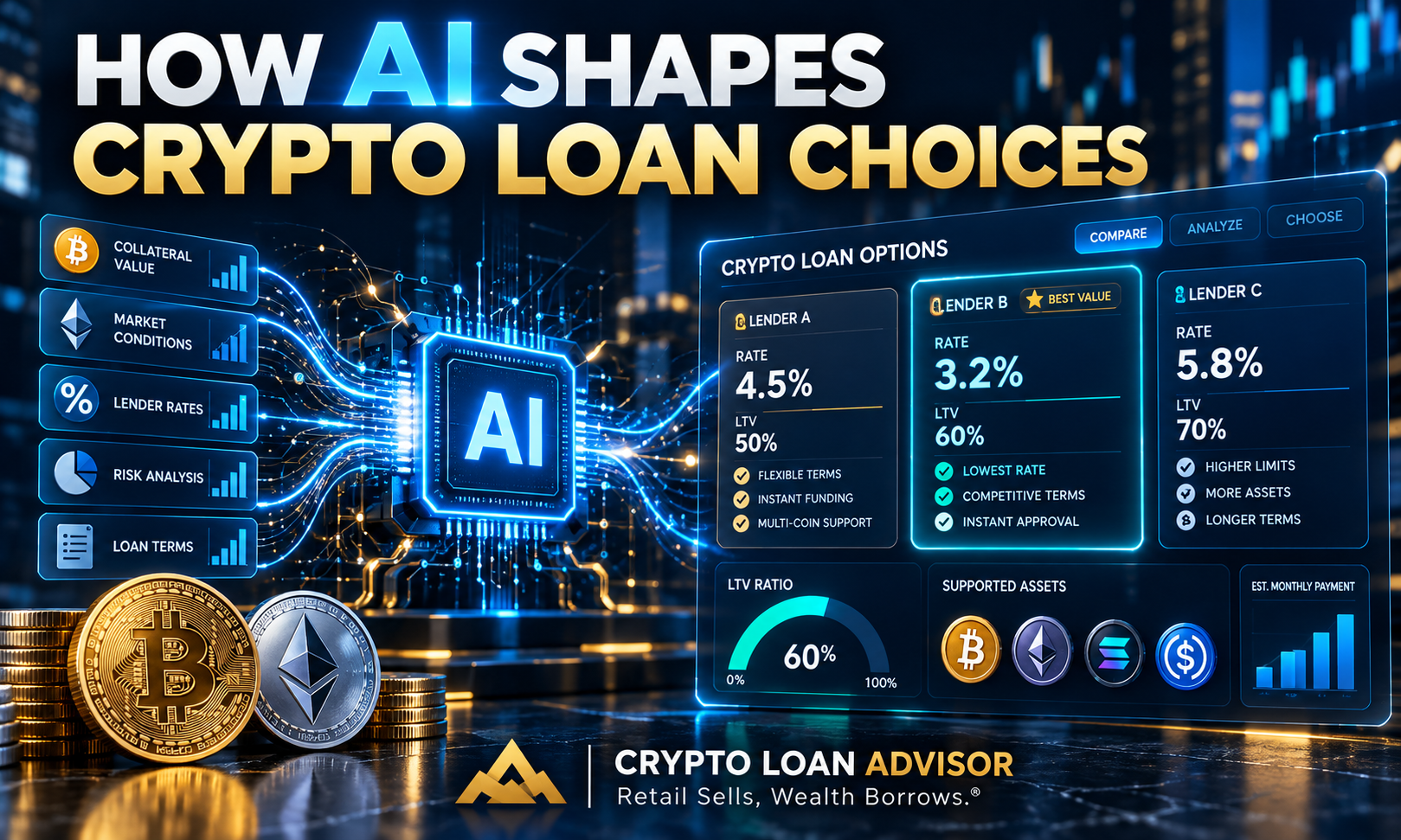
A Bitcoin holder who needs $50,000 for a business opportunity faces a very different decision from someone trying to borrow against crypto to buy more crypto. Both may encounter AI crypto borrowing tools promising a faster path to the right loan. The useful question is not whether the tool is intelligent. It is whether it helps you protect ownership, understand downside, and avoid taking more risk than your collateral can support.
Used well, AI can make crypto-backed borrowing easier to compare. Used carelessly, it can turn a high-stakes lending decision into a polished recommendation built on incomplete inputs. Borrow, don’t sell can be a powerful wealth strategy, but borrowing against a volatile asset still demands discipline.
What AI crypto borrowing tools can actually do
AI borrowing tools generally analyze information you provide – your collateral asset, desired loan amount, target term, income or liquidity needs, and risk preferences. Some can organize lender terms, estimate interest costs, model loan-to-value ratios, and flag scenarios where a price decline could create a margin call or liquidation risk.
That has practical value. Crypto loan terms are often presented differently across providers. One lender may emphasize a low starting rate but require a higher minimum loan balance. Another may offer a conservative LTV with more collateral protection. A third may support your preferred asset but have narrower availability, a shorter term, or different repayment options. AI can put those variables into a consistent format before you commit assets.
The best tools act like a decision worksheet with a faster interface. They can help translate a question such as, “How much can I borrow against 2 BTC?” into the questions that matter: What LTV would I start at? What price movement can my position absorb? What is the total borrowing cost? What happens if Bitcoin falls 20%, 35%, or 50%?
The numbers an AI tool should make clear
A useful recommendation should never stop at the loan amount. It should show the mechanics behind the recommendation in plain English.
Loan-to-value ratio
Loan-to-value, or LTV, is the loan amount divided by the market value of your collateral. If you pledge $100,000 in ETH and borrow $25,000, you begin at a 25% LTV. Lower starting LTV generally gives you more room for a decline in collateral value before the lender requires action.
An AI tool can calculate this instantly, but the calculation is only the beginning. A 50% LTV may look efficient because it provides more cash. For a long-term holder, however, it can leave little room for normal crypto volatility. The right LTV depends on the asset, your ability to add collateral or repay quickly, and how essential the borrowed cash is.
Margin call and liquidation levels
A margin call occurs when your collateral value falls enough that the lender asks you to restore the required collateral position, usually by adding assets or repaying part of the loan. Liquidation is the forced sale or conversion of collateral if the position reaches a specified threshold and you do not cure it under the lender’s terms.
This is where an AI scenario model can be genuinely helpful. It should show price levels, not merely percentages. If your liquidation point is tied to BTC falling to a specific price, seeing that number makes the risk more tangible. It also lets you ask a better question: Could I realistically respond if the market moved there overnight or during a weekend?
Interest, fees, and repayment structure
APR is not always the whole story. Borrowers should understand whether interest is paid monthly, whether it accrues to the loan balance, whether origination or administrative fees apply, and whether early repayment carries a cost. Variable-rate loans also deserve special attention because the rate that looks attractive at origination may not remain attractive through the term.
AI can estimate total cost, but it needs accurate lender terms and current rate information. Treat any output as a planning estimate until you verify the actual agreement. A decimal point, a collateral transfer requirement, or a rate-change clause can materially alter the economics.
Where AI can mislead crypto borrowers
AI is not a lender, a fiduciary, or a substitute for reading loan documents. Its confidence can create a false sense of certainty, especially when it delivers a clean answer to a messy financial decision.
First, its recommendation is only as good as its data. Loan rates, supported assets, geographic availability, collateral policies, and liquidation processes can change. If a tool relies on stale information or broad marketing claims, its comparison may be incomplete.
Second, it cannot know your full financial resilience unless you provide it. A tool may identify that you qualify for a larger loan, but it cannot decide whether that size is prudent. If a collateral call would force you to sell other investments, draw down emergency savings, or miss business payroll, the loan is too aggressive regardless of the model’s approval.
Third, AI tends to optimize measurable inputs. It can compare rate, LTV, and loan size. It has a harder time weighing operational trust, custody arrangements, counterparty exposure, support quality during market stress, and your personal ability to act quickly. Those are not secondary concerns. In crypto-backed lending, they are part of the risk.
A better way to use AI before borrowing
Use AI to pressure-test a borrowing plan, not to outsource judgment. Start with the purpose of the loan. Borrowing against appreciated BTC, XRP, ETH, or SOL for a tax payment, home purchase bridge, or business investment may preserve long-term exposure while creating needed liquidity. Borrowing to increase speculative exposure is a different proposition because the loan itself amplifies your dependence on market conditions.
Then enter conservative assumptions. If a tool asks for your acceptable risk level, do not choose “aggressive” simply because you are bullish. Ask it to model a 30% and 50% decline in the collateral asset, even if you believe that outcome is unlikely. Crypto markets do not need your permission to move quickly.
Finally, compare more than one structure. A smaller loan at a lower LTV can be more valuable than the maximum amount available because it preserves optionality. You may pay interest for liquidity, but you are also buying time and reducing the chance that a temporary drawdown turns into a permanent loss of assets.
Questions to ask before accepting a recommendation
Before moving collateral to any provider, make sure you can answer four practical questions:
- What is my starting LTV, and what collateral price triggers a margin call or liquidation?
- Can I add collateral, make partial repayments, or close the loan early without restrictive penalties?
- Who controls the collateral, how is it held, and what counterparty risks remain while the loan is open?
- If my asset falls sharply tonight, do I have cash or additional assets ready to protect the position?
If the answer to the last question is no, reduce the loan size or reconsider the loan entirely. A borrowing strategy should strengthen your flexibility, not make every market dip an emergency.
The standard for a useful AI recommendation
The strongest AI crypto borrowing tools do not push a single lender or pretend there is one universally best loan. They explain assumptions, identify missing information, and make trade-offs visible. A recommendation that says “you may qualify” is less valuable than one that says, “At this LTV, a 40% collateral decline would require this response, and this alternative structure provides more cushion.”
That is the standard informed borrowers should expect. CryptoLoanAdvisor’s role, like any independent education resource, is to help investors compare the decision before they compare providers. The asset may be digital, but the wealth-management principle is familiar: preserve valuable ownership, use leverage deliberately, and never confuse available credit with affordable risk.
The best borrowing decision will rarely feel dramatic. It will leave you with liquidity for the opportunity in front of you, a clear plan for market stress, and enough collateral cushion to remain a long-term holder when volatility returns.




