
The History of XRP.
Is It Really the Global Bridge Currency?
Bitcoin wanted to reinvent money. XRP wanted to reinvent how money moves.
That’s an important difference.
While Bitcoin emerged as decentralized peer-to-peer money, XRP was designed with a much more specific target in mind:
Move value around the world quickly, cheaply, and without requiring financial institutions to park piles of money in accounts around the globe.
More than a decade later, XRP remains one of crypto’s largest and most debated digital assets.
Supporters believe XRP could become a major bridge asset for global payments.
Critics ask a perfectly reasonable question:
If XRP is supposed to be the global bridge currency, when does the world actually start using the bridge?
Let’s go back to the beginning.
2011: What If We Built a Faster Bitcoin?
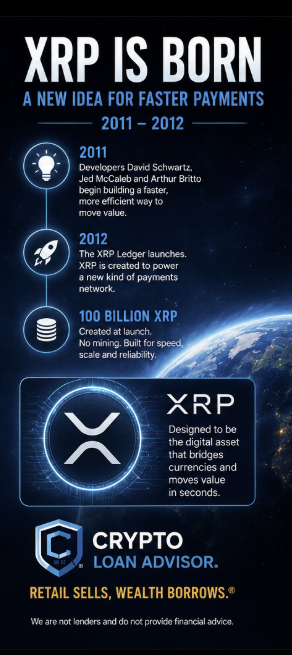
Bitcoin was barely two years old when developers David Schwartz, Jed McCaleb, and Arthur Britto began working on what would become the XRP Ledger.
They liked Bitcoin’s ability to transfer value without a central clearing authority.
But they saw limitations.
Bitcoin mining required substantial computing power. Transactions could be relatively slow. And they believed a different consensus system could be better suited for payments.
Their objective wasn’t simply:
“Let’s create another cryptocurrency.”
It was closer to:
“Can we build a digital network specifically designed to move value?”
Development began in 2011, and the XRP Ledger launched in 2012.
2012: XRP Is Born
When the XRP Ledger was created, 100 billion XRP were created. No mining. No Bitcoin-style proof-of-work. The entire supply existed from the beginning.
The founders ultimately allocated 80 billion XRP to the company that became Ripple to help develop an ecosystem and real-world uses for the network.
That structure has remained one of XRP’s most controversial features. Bitcoin advocates point to Bitcoin’s decentralized mining and fixed 21-million supply. XRP supporters respond that XRP wasn’t trying to become Bitcoin. It was trying to solve a different problem.
The Trillion-Dollar Problem XRP Wanted to Attack
Imagine a bank needs to move money from the United States to Mexico.
The customer starts with dollars. The recipient wants pesos. Traditionally, international payments can involve correspondent banks, foreign accounts, intermediary institutions, currency conversions, settlement delays and capital sitting in accounts waiting to be used.
It’s an enormous global machine. And much of it was built decades before anyone had an iPhone.
XRP’s proposition was intriguing: What if a digital asset could sit in the middle?
Instead of: USD → banking intermediaries → foreign accounts → MXN you could potentially have: USD → XRP → MXN
XRP wouldn’t necessarily be the money everyone ultimately wants to hold. It could be the asset that temporarily bridges two forms of money. That’s where the phrase “bridge currency” comes from.
The XRP Ledger says XRP can settle transactions in roughly 3–5 seconds, and Ripple currently describes XRP as capable of bridging currencies for banks, payment providers and fintech companies.

Why Would Anyone Need a Bridge Currency?
Here’s an easy way to think about it.
Suppose you want to travel from Detroit to Tokyo.
You probably don’t care very much about the airport where you change planes.
You care about getting to Tokyo.
The connecting airport is the bridge.
That’s essentially the XRP thesis.
A company doesn’t necessarily need to hold XRP forever.
It could theoretically use XRP for several seconds to move from one currency or asset into another.
Dollar → XRP → Peso
Euro → XRP → Yen
Fiat → XRP → Digital Asset
The more currencies and markets connected to that central pool of liquidity, the more useful the bridge potentially becomes.
At least, that’s the theory.
Ripple Enters the Banking World
This is where the XRP story gets interesting.
Many early crypto projects viewed banks as dinosaurs waiting for extinction. Ripple took almost the opposite approach.
Instead of saying: “Destroy the banks.” Ripple essentially said: “We think we can help banks move money better.”
That meant pursuing relationships with financial institutions, payment companies, fintech firms and governments.
It wasn’t nearly as rebellious. But it was potentially a very large business opportunity. Cross-border payments represent trillions of dollars in annual financial activity. If blockchain technology could capture even a fraction of those flows, the opportunity could be enormous.
But Ripple and XRP Are Not the Same Thing
This distinction is critical.
Ripple is a company.
XRP is a digital asset.
The XRP Ledger (XRPL) is the underlying decentralized ledger/network.
You can use XRP without owning Ripple. Ripple can also develop products that don’t require every transaction to use XRP.
That last point becomes particularly important when evaluating the “global bridge currency” argument.
2020: Then the SEC Arrived
On December 22, 2020, the U.S. Securities and Exchange Commission sued Ripple Labs and executives Brad Garlinghouse and Chris Larsen.
The SEC alleged that Ripple’s XRP sales involved unregistered securities offerings.
For XRP holders, it was a bombshell.
Some U.S. exchanges suspended XRP trading. Uncertainty hung over the project. And one of America’s largest crypto regulatory battles began.
Then came a major development.
A federal court concluded that Ripple’s institutional XRP sales constituted unregistered securities transactions, while certain programmatic sales on digital-asset exchanges did not.
After years of litigation, both sides ultimately dismissed their appeals in August 2025, leaving the court’s rulings and the $125 million penalty in place.
For XRP, removing years of U.S. litigation uncertainty was a significant milestone.
So… Is XRP Really the Global Bridge Currency?
Here’s where we separate the marketing slogan from reality.
The technology says: It can be.
XRP was specifically designed for payments.
Transactions settle within seconds.
The network operates around the clock.
XRP can trade against numerous currencies and digital assets.
Ripple’s payment infrastructure can use XRP as an intermediary asset to bridge currencies. Ripple says its payment system can convert fiat into a digital asset such as XRP, transfer it over XRPL, and convert it into the destination currency.
So technically:
Yes. XRP can function as a bridge currency.
But that’s different from saying:
XRP is the global bridge currency.
Today, that would be an exaggeration.
The Competition Has Changed
When XRP’s strategy was developed, stablecoins weren’t the enormous financial category they are today.
Now they matter.
A lot.
Dollar-backed stablecoins can also move value across blockchain networks rapidly.
Ripple itself now operates RLUSD, a dollar-backed stablecoin, and its current payment infrastructure describes transactions using digital assets such as XRP or RLUSD.
That’s an important development.
XRP isn’t competing only with slow correspondent banking anymore.
It’s also competing—or potentially cooperating—with:
Stablecoins
Tokenized bank deposits
Central-bank digital currencies (CBDCs)
Other blockchains
Future institutional settlement networks
The bridge has become a crowded highway.
Here’s Where XRP Could Become Very Interesting
The biggest XRP opportunity may not require replacing the dollar, euro, peso, or yen.
It may be connecting them.
Imagine a future financial world containing:
Traditional currencies
Stablecoins
Tokenized stocks
Tokenized bonds
Real-world assets
Bank deposits
Cryptocurrencies
Those assets will need liquidity and settlement infrastructure between them.
XRP doesn’t necessarily have to become the world’s currency to succeed.
It could potentially become one of the assets helping the world’s currencies and digital assets communicate with each other.
That’s a very different proposition.
And arguably a more realistic one.
The $100 Trillion Question
Suppose trillions of dollars eventually move across blockchain-based financial infrastructure.
Does XRP capture:
1%?
5%?
20%?
Or almost none of it?
Nobody knows.
And that’s the investment debate surrounding XRP.
The bullish argument says XRP has spent more than a decade building specifically for institutional payments and global liquidity.
The bearish argument says faster payment technology doesn’t automatically create demand for XRP itself—and stablecoins or other technologies could perform many of the same functions.
Both arguments deserve consideration.

XRP Doesn’t Need to Replace the Dollar
This may be the biggest misunderstanding about XRP.
For XRP to become successful as a bridge asset:
People don’t necessarily need to buy groceries with XRP.
Employers don’t need to pay salaries in XRP.
Governments don’t need to abandon their currencies.
Banks don’t even necessarily need to hold massive quantities of XRP permanently.
XRP’s role could happen largely behind the scenes.
You send dollars.
The recipient receives pesos.
XRP potentially exists in the middle for only a few seconds.
The customer might never even know it happened.
That is what a true bridge asset would look like.
The Crypto Loan Advisor Perspective
At Crypto Loan Advisor, XRP is particularly interesting for another reason.
As digital assets become more integrated into mainstream finance, established crypto assets may increasingly become usable as collateral.
Bitcoin currently dominates much of the crypto-backed lending market.
But borrowers increasingly want options involving other established digital assets.
That raises an interesting question:
If XRP becomes increasingly integrated into global financial infrastructure, could XRP also become a more widely accepted collateral asset?
Potentially.
But utility, market price, and collateral quality aren’t the same thing.
Lenders still need to consider:
Volatility
Liquidity
Custody
Liquidation procedures
Loan-to-value ratios
Counterparty risk
And borrowers need to understand exactly what happens to their XRP if the market moves against them.
So, Is XRP the Global Bridge Currency?
Not today.
But XRP was designed to perform that job, the XRP Ledger can technically support that role, and Ripple continues building payment infrastructure in which XRP can be used as a bridge asset.
The better question isn’t:
“Is XRP already the world’s bridge currency?”
It’s:
“Can XRP become one of the major bridges connecting the traditional financial system with the emerging digital financial system?”
That’s the bet.
Bitcoin’s story is largely about digital scarcity and storing value.
XRP’s story is about moving value.
And if trillions of dollars eventually move across blockchain networks every day, owning part of the infrastructure—or the liquidity connecting that infrastructure—could become very interesting.
The bridge is built.
Now we find out how much traffic actually crosses it.
Retail Sells, Wealth Borrows.®
Crypto Loan Advisor is not a lender and does not provide financial, investment, tax, or legal advice. Digital assets and crypto-backed loans involve significant risks, including volatility and collateral liquidation. References to XRP’s potential future adoption or use as a bridge asset are not predictions or guarantees of future performance.