
A 9% quote can be cheap or dangerously expensive. The difference is not just the advertised number. For crypto rates, the real question is how much liquidity you receive, what assets you post, how quickly your collateral can be sold, and what the loan costs if markets move against you.
For long-term Bitcoin, XRP, Ethereum, or Solana holders, borrowing can preserve ownership while creating usable cash or stablecoin liquidity. That is the appeal behind the Borrow, Don’t Sell approach. But a crypto-backed loan is not a simple line item on a rate sheet. It is a financing decision tied to a volatile asset, a lender’s risk controls, and your ability to withstand changing market conditions.
What crypto rates usually mean for borrowers
In a borrowing context, crypto rates generally refer to the interest charged on a loan secured by digital assets. The rate may be expressed as APR, a simple annual percentage rate, or APY, an annualized figure that can reflect compounding. Those terms are not interchangeable, so borrowers should confirm how interest accrues and when it is due.
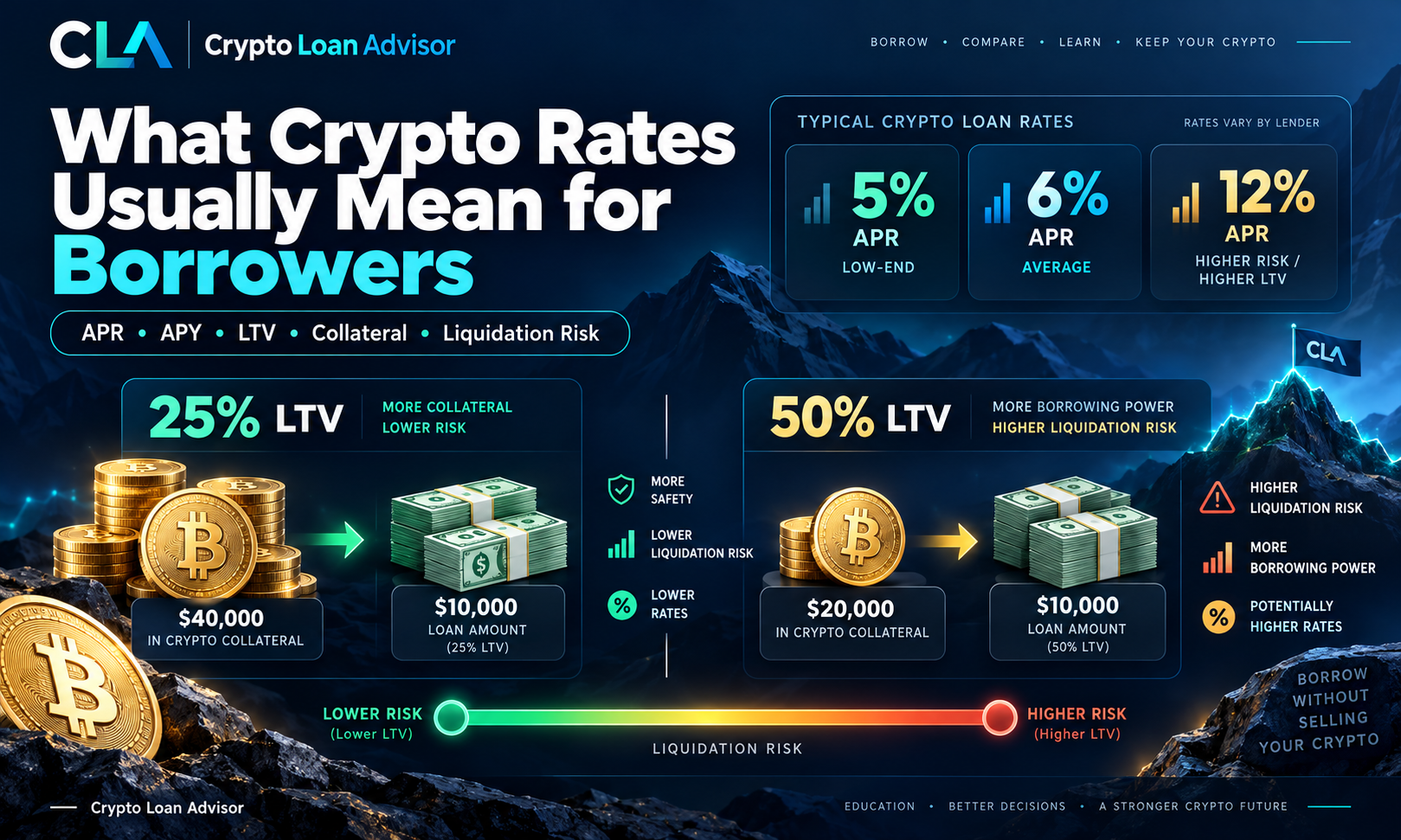
A lender may quote a rate as low as 5% or 6%, while another quotes 12% or more. Neither number tells the whole story on its own. A lower rate often comes with a lower loan-to-value ratio, meaning you must post more collateral for each dollar borrowed. A higher rate may allow more borrowing power, longer repayment flexibility, or a different collateral arrangement.
For example, a borrower seeking $50,000 against Bitcoin may receive a 25% LTV offer requiring roughly $200,000 in collateral. At 50% LTV, the same loan may require about $100,000 in collateral, but the interest rate and liquidation risk may be higher. The right structure depends on whether preserving a wide safety margin or accessing more capital is the priority.
The advertised APR is only the starting point
Think of a crypto loan rate as one component of the total borrowing cost. Before transferring collateral, read the terms for origination charges, administrative fees, stablecoin conversion costs, withdrawal fees, prepayment rules, late-payment charges, and any spread applied when collateral is liquidated.
A 7% APR with a 2% origination fee can cost materially more than a 9% loan with no upfront charge, especially if you intend to repay within a few months. On a one-year $50,000 loan, the first structure begins with a $1,000 cost before interest. If the loan is repaid early, that upfront fee has an outsized effect on the effective rate.
The denomination of the loan matters, too. Borrowing U.S. dollars or dollar-pegged stablecoins creates a different risk profile than borrowing another crypto asset. If you borrow a volatile token and its dollar value rises sharply, your repayment obligation can become more expensive even if your collateral performs well. Most borrowers seeking predictable spending power prefer to evaluate costs in dollars.
Fixed rates versus variable rates
A fixed rate provides planning certainty. If you borrow for a known business expense, tax obligation, real estate deposit, or portfolio allocation, knowing the interest cost in advance can be valuable.
Variable rates can begin lower but change as market liquidity, lender demand, or platform policy shifts. That may be acceptable for a short-duration loan you plan to repay quickly. It is less attractive when your financial plan depends on a stable carrying cost over many months. Ask whether a quoted rate is locked at origination, subject to periodic adjustment, or promotional for only part of the term.
LTV can matter more than the rate
Loan-to-value ratio, or LTV, compares the amount borrowed with the value of the collateral. It is one of the clearest indicators of how much market room your loan has.
If you pledge $100,000 of ETH and borrow $25,000, your starting LTV is 25%. If ETH falls 40%, your collateral value drops to $60,000 and your LTV rises to about 42%. You have not borrowed more money, but your position has become riskier because the collateral base has shrunk.
At a higher starting LTV, the same market decline can push the loan toward a margin call or liquidation threshold. A lender may ask you to add collateral, make a partial repayment, or reduce the balance automatically by selling assets. Each provider defines these triggers differently, which is why an attractive rate without clear risk thresholds is not a complete offer.
A lower LTV can feel inefficient because more of your portfolio is pledged for less borrowed capital. In return, it buys time. Time matters when crypto markets can move 10% or 20% before a borrower has the opportunity to respond. For many high-conviction holders, a conservative LTV is the price of retaining upside exposure without turning ordinary volatility into a forced-sale event.
Compare the liquidation path, not just the liquidation number
A liquidation threshold is often presented as a single percentage, such as 70% or 80% LTV. That figure is useful, but it does not explain the full process. Borrowers need to know what happens before, at, and after that threshold.
Review four practical questions:
- At what LTV does the lender issue a margin call or request additional collateral?
- How much notice is provided, and through which channels?
- Can you repay, add collateral, or both to cure the position?
- Does the lender liquidate all collateral or only enough to restore the required LTV?
The answers determine whether a loan is manageable during a fast downturn. A platform with a slightly higher APR but transparent alerts, reasonable cure procedures, and partial-liquidation mechanics may be preferable to a cheaper option with limited communication or broad discretion to sell collateral.
Collateral concentration also deserves attention. Borrowing against a single token can be straightforward, but it exposes the loan to the price behavior of that asset. Bitcoin may have a different volatility profile than Solana, while XRP and ETH can react differently to market, regulatory, and network-specific developments. Some lenders assign different maximum LTVs and crypto rates by asset because their internal risk models treat each token differently.
How loan term changes the meaning of the rate
A low annual rate does not automatically make a long loan better. The longer the loan remains outstanding, the longer you carry both interest expense and collateral-market risk. If your purpose is temporary liquidity, a shorter term with a clear repayment source may be more disciplined than rolling a loan forward repeatedly.
On the other hand, a longer term can make sense when you need predictable liquidity and have a realistic plan to service interest without selling pledged collateral at an unfavorable moment. The key is not to assume that future appreciation will solve the repayment problem. Appreciation is possible, not guaranteed, and loans should survive a scenario where the market falls first.
Build your decision around cash flow. Can you pay interest from income, business revenue, or separate liquid reserves? If the answer is no, you may be relying on collateral appreciation to support a debt obligation. That can work in a strong market, but it creates pressure precisely when markets weaken.
A practical framework for comparing crypto loan offers
When comparing providers, place the offers on the same footing. Use the same loan amount, collateral asset, starting LTV, term, and repayment assumption. Then calculate the dollar interest cost, add all known fees, and map the collateral price decline that would trigger a margin call and liquidation.
A disciplined comparison should account for:
- The stated APR or APY and whether it is fixed or variable
- Required collateral, starting LTV, and accepted assets
- Margin-call and liquidation thresholds, including notice periods
- Upfront, recurring, and exit fees
- Interest payment schedule, prepayment options, and maturity treatment
- Custody structure, security practices, and the legal terms governing collateral
This is also where lender reliability matters. Crypto-backed borrowing requires you to place valuable assets within someone else’s operating and legal framework. Review whether the provider explains custody clearly, identifies who controls collateral, discloses rehypothecation or lending practices where applicable, and publishes understandable terms. A rate is only valuable if the lender and loan structure support the strategy behind it.
CryptoLoanAdvisor’s role is to help borrowers evaluate these trade-offs independently, rather than treating the lowest advertised number as the automatic winner. Rate shopping is useful. Structure shopping is essential.
When paying a higher rate may be rational
The lowest rate is not always the best rate. Paying more can be rational if it materially lowers your starting LTV, offers a longer margin-call response window, permits penalty-free prepayment, or provides terms that fit your planned use of funds.
Likewise, the cheapest loan can be the wrong choice if it leaves little room for volatility. Borrowing at 50% LTV to save two percentage points of interest may not be worthwhile for an investor who would be forced to sell core Bitcoin holdings after a routine market correction. The savings are real, but so is the risk.
Borrow with a rate you can afford, an LTV you can defend, and terms you can explain in plain English. That is how liquidity remains a wealth-management tool rather than becoming a forced sale waiting for a volatile week.




