Uncategorized

A bold graphic featuring a large gold Bitcoin coin on the left and the title “The History of Bitcoin” in big gold lettering on a dark background.
Crypto Pulse, Uncategorized

The History of Bitcoin

Bitcoin started as an idea shared with a small group of cryptography enthusiasts. Today, it’s a global asset that has changed how millions of people think about money, ownership, and financial freedom. But how did Bitcoin actually get here — and what were the key moments that shaped its journey? From Satoshi Nakamoto to the rise of a trillion-dollar crypto market, discover the story behind Bitcoin. 👉 Read the full story: The History of Bitcoin

Crypto Loan Advisor graphic showing crypto collateral converted to cash in minutes through Lantern Finance and the RTP Network, with a loan dashboard, real-time payment rail, and funds arriving in a U.S. bank account.
Uncategorized

From Crypto Collateral to Cash in Minutes: My Experience With Lantern Finance and the RTP Network

There are plenty of things in crypto that sound great in theory. Then there are the things you actually use—and think, “Wow. That really worked.” For me, one of those moments came when I experienced the Real-Time Payments (RTP®) network while using Lantern Finance. I’ve been around financial services and crypto long enough to know that moving money is often the least exciting—and most frustrating—part of the process. You can have a loan approved, your collateral in place and everything ready to go, only to hear: “Your funds should arrive in one to three business days.” And if it happens to be Friday afternoon? See you Monday. Maybe Tuesday. But that wasn’t my experience with Lantern Finance. From Lantern Finance to My Bank—Almost Instantly Lantern Finance has integrated its loan funding process with the RTP network operated by The Clearing House, allowing eligible borrowers to receive U.S. dollar loan proceeds directly into participating bank accounts extraordinarily quickly. I experienced it personally. The funds moved from Lantern Finance to my bank account in what felt like real time. No waiting several business days. No wondering where the transfer was. No checking the account tomorrow morning. The money was simply there. For someone accustomed to traditional banking rails, it was one of those moments where you realize how dramatically financial infrastructure is changing. And here’s the important part: RTP isn’t some experimental crypto payment network. It’s major U.S. banking infrastructure. The Clearing House launched the RTP network in 2017. Today it operates 24 hours a day, 7 days a week, 365 days a year—including weekends and bank holidays. As of July 2026, The Clearing House reported more than 1,300 participating financial institutions on the network. Your Bank May Already Be Connected This isn’t limited to a handful of specialty banks. Major institutions including JPMorgan Chase, Bank of America, Wells Fargo and Citi, along with hundreds of regional banks, community banks and credit unions, participate in the RTP ecosystem. Lantern Finance says the network now reaches more than 70% of U.S. bank accounts. Even better, you don’t have to guess whether your bank participates. The Clearing House maintains information on participating financial institutions so consumers can determine whether their bank is connected to the RTP network. Is Your Bank Connected to RTP? Visit TheClearingHouse.org to learn more about the RTP network and check whether your financial institution participates. Check before you need the money. If your bank is connected to RTP, you may be able to receive eligible Lantern Finance loan proceeds dramatically faster than through traditional bank-transfer methods. Why This Matters for Crypto-Backed Lending This is where things get particularly interesting. Crypto trades 24/7. Bitcoin doesn’t close at 5:00 PM. Ethereum doesn’t take Saturdays off. The crypto market doesn’t stop because Monday happens to be a federal holiday. Yet historically, borrowers could hold a 24/7 digital asset and still depend on banking infrastructure built around business hours. That’s a mismatch. RTP helps close that gap. According to Lantern Finance, borrowers who link an eligible bank account at the payout stage can receive approved loan proceeds within about 10 minutes, including nights, weekends and holidays. If the bank isn’t connected to RTP, the transfer generally falls back to traditional ACH processing. The Clearing House itself specifically identifies consumer loan disbursements as one of the use cases for RTP because real-time payments can eliminate the delays associated with traditional ACH funding. That may sound like a small improvement. I don’t think it is. Liquidity Is About More Than Getting Approved When people compare crypto-backed lenders, they naturally look at things like: Those are all important. But there is another question worth asking: Once my loan is approved, how quickly can I actually use the money? A loan that exists on a lender’s dashboard isn’t necessarily the same thing as cash sitting in your bank account. That’s one reason I think what Lantern Finance is doing with RTP deserves attention. They are connecting two very different financial worlds: digital assets that operate around the clock and America’s rapidly evolving real-time banking infrastructure. And as someone who has actually used it, I can tell you the difference isn’t theoretical. You notice it immediately. The Future of Borrowing May Be Real Time We talk constantly about innovation in crypto—blockchains, stablecoins, tokenization, DeFi and digital assets. But sometimes the most meaningful innovation happens when new technology connects seamlessly with the financial system people already use. You borrow against your crypto. Your loan is approved. Your bank participates in RTP. And your dollars can arrive almost immediately. That’s simple. That’s useful. And after personally experiencing it through Lantern Finance, I came away impressed. The future of financial services isn’t only about crypto replacing traditional banking. It may be about the two systems finally learning how to work together—in real time. Important Disclosure This article reflects my personal experience using Lantern Finance and the RTP network. Crypto Loan Advisor is not a lender, and I am not a financial advisor. Nothing in this article should be considered financial, investment, tax or legal advice. Crypto-backed loans involve significant risks, including collateral volatility, margin calls and liquidation. Always review a lender’s terms, risks, fees and eligibility requirements before borrowing.

Bitcoin pros and cons graphic highlighting Bitcoin’s fixed 21 million supply, global 24/7 access, institutional adoption and borrowing potential, alongside risks including extreme volatility, liquidation, lost private keys, scams, hackers and regulatory uncertainty. CryptoLoanAdvisor — “Retail Sells, Wealth Borrows.”®
Uncategorized

BITCOIN: Brilliant Idea, Financial Revolution… or a Very Expensive Roller Coaster?

Bitcoin has been called digital gold, internet money, a revolution, a scam, an inflation hedge—and a casino.After more than 15 years, one thing is certain:Bitcoin isn’t boring.🟢 THE PROS₿ Only 21 million Bitcoin — No central bank can simply create another 10 million.🌎 Global & 24/7 — Bitcoin doesn’t close for weekends, holidays, or banker hours.🏦 No bank required — Value can move peer-to-peer without traditional financial intermediaries.📈 Institutional adoption — Bitcoin has moved from the financial fringe into ETFs, asset managers, corporations, and institutional portfolios.💰 Borrow without selling — Bitcoin can potentially be used as collateral to access liquidity while maintaining exposure to the asset.🔴 THE CONS🎢 Extreme volatility — Bitcoin can make a traditional stock-market correction look like a warm-up.⚠️ Liquidation risk — Borrow against Bitcoin and a major price decline can quickly push your LTV toward a margin call or liquidation.🔐 You are your own bank — Lose your keys or seed phrase and there may be no “Forgot Password” button.🥷 Scams & hackers — Crypto attracts innovation. Unfortunately, it also attracts people trying to steal your crypto.⚖️ Regulatory uncertainty — Bitcoin may be decentralized, but exchanges, lenders, custodians and investors still operate in a regulated world.So is Bitcoin brilliant or insane?Maybe a little of both.The better question isn’t simply:“How high can Bitcoin go?”It’s:👉 “Can you survive it if Bitcoin goes down?”Because understanding the downside may be more important than chasing the upside. Retail Sells, Wealth Borrows.®#Bitcoin #BTC #Crypto #Cryptocurrency #DigitalAssets #BitcoinLoans #CryptoLending #Investing

Uncategorized

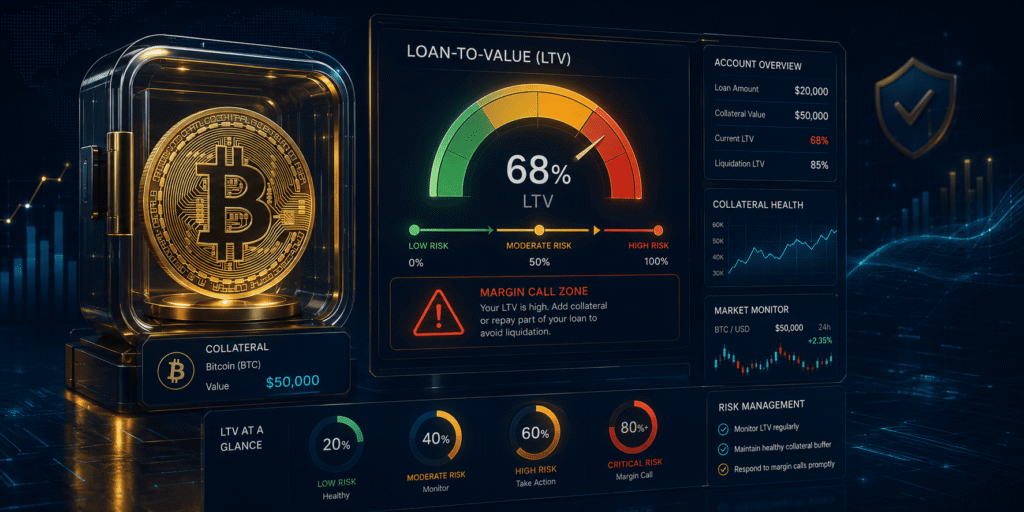
Margin Calls Explained: What Every Crypto Borrower Should Know

Category: Risk Management What Is a Margin Call? One of the most important concepts in crypto-backed lending is the margin call. A margin call occurs when the value of your collateral falls and your Loan-to-Value (LTV) ratio rises beyond a lender’s acceptable threshold. When this happens, the lender may require you to take action to reduce risk. Understanding margin calls before borrowing can help you avoid unexpected liquidations and protect your assets. Why Margin Calls Happen Crypto markets can be highly volatile. When you take a crypto-backed loan, your digital assets serve as collateral. If the value of that collateral drops significantly, the lender’s risk increases. To manage that risk, lenders establish LTV limits and margin call thresholds. When those thresholds are exceeded, a margin call may be triggered. A Simple Example Imagine you deposit $100,000 worth of Bitcoin as collateral and receive a $50,000 loan. Initial LTV: 50% If Bitcoin’s value falls to $70,000 while your loan remains $50,000, your LTV increases to 71.4%. Depending on the lender’s policies, this increase could trigger a margin call. What Happens During a Margin Call? When a margin call occurs, lenders typically provide several options: Add More Collateral Deposit additional cryptocurrency to reduce your LTV ratio. Repay Part of the Loan Pay down a portion of the outstanding balance. Reduce Risk Exposure Take steps required by the lender to restore acceptable collateral levels. The specific process varies between lenders. What Happens If You Ignore a Margin Call? If no action is taken, the lender may liquidate part or all of the collateral. Liquidation means assets are sold to recover the outstanding loan balance. This is one of the biggest risks associated with crypto-backed borrowing. How to Reduce Margin Call Risk Borrow Conservatively Lower LTV ratios generally provide a larger safety buffer. Monitor Your Collateral Keep track of significant market movements affecting your assets. Maintain Reserve Funds Having additional collateral available can help during volatile periods. Understand Your Lender’s Rules Every platform has different margin call and liquidation thresholds. Questions to Ask Before Borrowing Before taking a crypto-backed loan, ask: Knowing these answers can help you prepare for changing market conditions. The Bottom Line Margin calls are not necessarily a sign that something has gone wrong. They are simply part of the risk management framework used by crypto lenders. The key is understanding how they work before borrowing. Investors who understand LTV, monitor their collateral, and maintain adequate safety buffers are often better positioned to navigate market volatility. At CryptoLoanAdvisor, our mission is simple: Help people make better borrowing decisions.

Scroll to Top