
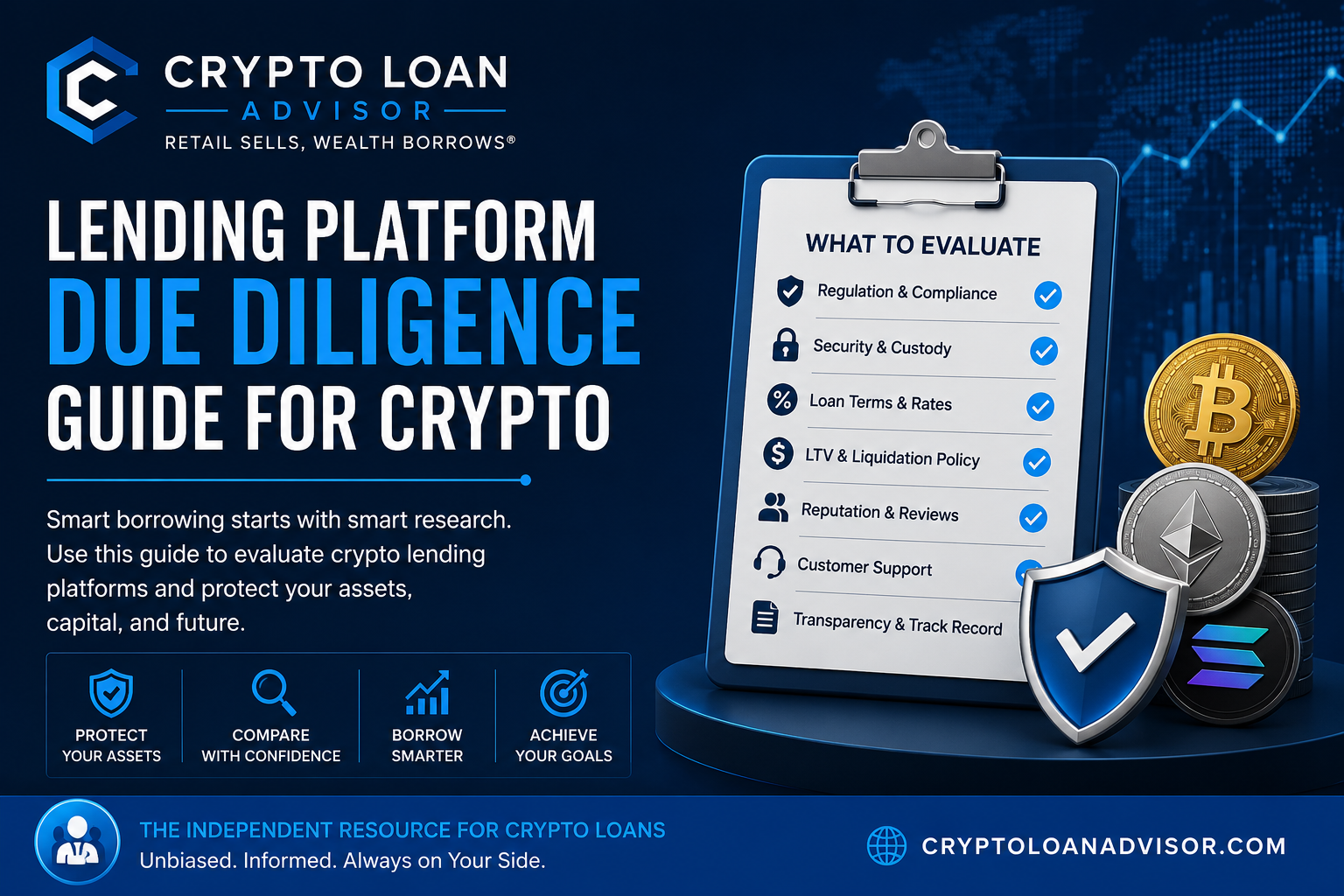
A crypto-backed loan can turn long-term holdings into usable liquidity without forcing a sale. But that benefit only exists if the lender, custody arrangement, and loan contract can withstand stress. This lending platform due diligence guide gives Bitcoin, XRP, Ethereum, Solana, and other digital-asset holders a disciplined way to evaluate a provider before transferring collateral.
Borrow, don’t sell is a wealth strategy, not a shortcut around risk. A borrower preserves potential upside and may avoid realizing a taxable sale, but takes on a new set of obligations: interest expense, collateral volatility, counterparty exposure, and the possibility of liquidation. The platform deserves as much scrutiny as the loan rate.
Start With the Question Behind the Loan
Before comparing lenders, define why you are borrowing. Short-term working capital, a tax payment, a real estate down payment, business investment, and portfolio diversification each call for a different loan structure. A loan that looks attractive at a low introductory rate may be a poor fit if it has a short term, restrictive repayment rules, or an aggressive liquidation process.
Also define the amount of market risk you can accept. If you would lose sleep or face financial hardship after a 35% decline in your collateral, borrowing near the platform’s maximum loan-to-value ratio is unlikely to be prudent. The lender’s advertised maximum is a capacity figure, not a recommendation.
Evaluate the Company Before Its Rate Sheet
Interest rates are easy to compare. Counterparty quality requires more work, and it matters more. When you pledge crypto, you are assessing not just a product but the organization responsible for safeguarding assets, administering margin requirements, and honoring its contractual commitments.
Start with the platform’s legal identity. A credible provider should clearly disclose the entity you are dealing with, its headquarters, operating jurisdictions, licensing or registration where applicable, and the governing law of its agreements. Vague corporate disclosures, changing entity names, or a lack of accessible legal documents deserve caution.
Then look at the business model. Is the company a direct lender, a broker matching borrowers with lending partners, a decentralized protocol, or a yield platform that rehypothecates assets? These models carry different risks. A broker may provide choice but add another party to the process. A direct lender may offer clearer servicing but still rely on outside capital. A protocol can reduce reliance on a corporate intermediary while introducing smart-contract, oracle, and self-custody risks.
Ask how the platform funds loans and manages its own liquidity. No provider can eliminate market stress, but transparent explanations of capital sources, credit policies, reserves, and risk controls are more meaningful than broad claims of safety. Be especially careful when a lender promotes unusually high yields, unusually low rates, or instant approval without explaining how the economics work.
Custody Is Part of the Credit Decision
Crypto collateral is not just an account balance. Determine exactly where it sits after transfer, who controls the private keys, and what happens if the lender faces operational or financial distress.
A platform should explain whether assets are held with a qualified third-party custodian, in segregated wallets, in omnibus wallets, or through another structure. Segregation can help clarify records and asset treatment, but it does not automatically make collateral bankruptcy-proof. The loan agreement and the applicable legal framework determine your rights.
Review whether the lender can lend, stake, trade, or otherwise rehypothecate your collateral. Some borrowers will accept that arrangement in exchange for lower pricing or broader access. Others will consider it a nonstarter. The key is knowing the trade-off before funding the account, rather than discovering it in the fine print after a market decline.
Security practices matter as well. Look for clear information on cold storage, multi-signature controls, withdrawal protections, internal access policies, audits, and incident response. A security page full of generic assurances is not the same as a transparent custody model. If the platform cannot explain how it protects and accounts for pledged assets, do not assume the best-case scenario.
Read the Loan Terms Like a Risk Manager
The annual percentage rate or stated interest rate is only one component of borrowing cost. Review whether interest is simple or compounded, when it accrues, whether it is paid monthly or added to principal, and whether rates are fixed or variable. Calculate the dollar cost over the expected life of the loan, including origination, withdrawal, servicing, late-payment, and collateral-management fees.
The core risk metric is loan-to-value ratio, or LTV. It measures the loan balance as a percentage of your collateral value. If you pledge $100,000 in Bitcoin and borrow $25,000, your opening LTV is 25%.
More critical than the opening LTV is the gap between your opening LTV, margin-call threshold, and liquidation threshold. Suppose a lender issues a loan at 30% LTV, sends a margin call at 55%, and begins liquidation at 65%. That structure gives more room for volatility than a loan starting at 50% LTV with liquidation at 65%, even though both may advertise the same maximum borrowing limit.
Ask four direct questions:
- How frequently is collateral priced, and which market data source is used?
- At what LTV will I receive a warning, and how much time will I have to act?
- Can I add collateral, repay principal, or both to restore the required LTV?
- Does the platform liquidate all collateral at once or only enough to cure the deficit?
The answers determine whether you have a workable response plan during a fast sell-off. Platforms may have discretion under extreme volatility, exchange outages, or thin liquidity. Read those provisions carefully. A threshold is not always a promise that you will receive a convenient window to act.
Stress-Test the Loan Before You Take It
Do not evaluate a loan based only on the current crypto price. Run a simple downside scenario. If your collateral drops 25%, 40%, and 60%, what happens to your LTV? How much cash or additional crypto would you need to contribute to avoid liquidation? Would you realistically have access to those funds during a broad market drawdown?
This exercise often leads disciplined borrowers to use less leverage than a platform permits. A lower initial LTV may feel conservative during a bull market, but it buys time when volatility returns. For many long-term holders, preserving the underlying position is the point of borrowing. Avoid a loan structure that makes a temporary price decline likely to force the sale you were trying to avoid.
Consider concentration risk too. Borrowing against a single token can be efficient, but it ties the loan’s safety to that asset’s volatility and liquidity. Bitcoin may behave differently from XRP, Ether, or Solana in a stress event. Not every lender supports every asset under the same LTV rules, custody setup, or liquidation policy.
Assess the Borrower Experience Under Pressure
A polished dashboard is useful, but the real test is what happens when collateral approaches a threshold. Review the platform’s communication channels, hours of operation, notification methods, and escalation process. Email-only support may be adequate for routine questions but insufficient for time-sensitive collateral events.
Look for clear disclosures around withdrawal timing, loan funding time, repayment processing, and collateral release after payoff. If you repay in full, when can you expect assets to be available? Can the provider delay releases for compliance reviews, network congestion, or other operational reasons? These are reasonable possibilities, but they should be stated plainly.
Check whether the agreement permits the lender to change rates, LTV limits, eligible collateral, or other material terms. Some flexibility may be necessary in volatile markets. Still, the contract should describe how changes are communicated and what options borrowers have if conditions become less favorable.
Use Independent Signals, Not Just Testimonials
Marketing testimonials show how a product performed for selected customers. They do not establish a lender’s financial strength or legal reliability. Seek evidence that is harder to curate: legal disclosures, audited financial information when available, named custody partners, leadership history, regulatory actions, complaint patterns, and a consistent record of communicating through difficult market conditions.
Independent comparison resources can help organize this research, but no review can replace reading the actual agreement you will sign. Terms can change, and the appropriate lender for one borrower may be unsuitable for another. A borrower seeking a modest, low-LTV loan may prioritize custody and conservative liquidation terms, while an entrepreneur with predictable cash flow may place more weight on funding speed and repayment flexibility.
Make the Transfer the Final Step
Do not send collateral merely because an application appears approved. Confirm the wallet address through the platform’s official authenticated process, use test transfers when practical, enable account security controls, and retain records of every transfer, loan statement, and notice. Never rely on a wallet address sent through an unsolicited message or a social-media account.
Crypto-backed borrowing can preserve ownership and expand financial flexibility, but only when the loan is built to survive the conditions you cannot predict. Choose a lender whose custody, terms, and communication you understand well enough to hold your position with confidence when the market gets uncomfortable.




