
A crypto loan can preserve your Bitcoin, Ethereum, XRP, or Solana exposure while giving you cash for an opportunity, expense, or tax bill. But recourse versus nonrecourse crypto loans determines what happens when the collateral falls sharply and liquidation does not fully repay the balance. That distinction can matter far more than a slightly lower interest rate.
For long-term holders, borrowing can be a disciplined alternative to selling. Retail sells. Wealth borrows – but only when the borrower understands the downside, maintains adequate liquidity, and chooses terms that match the risk. The first question is not simply, “How much can I borrow?” It is, “What am I responsible for if this loan goes wrong?”
What recourse and nonrecourse mean
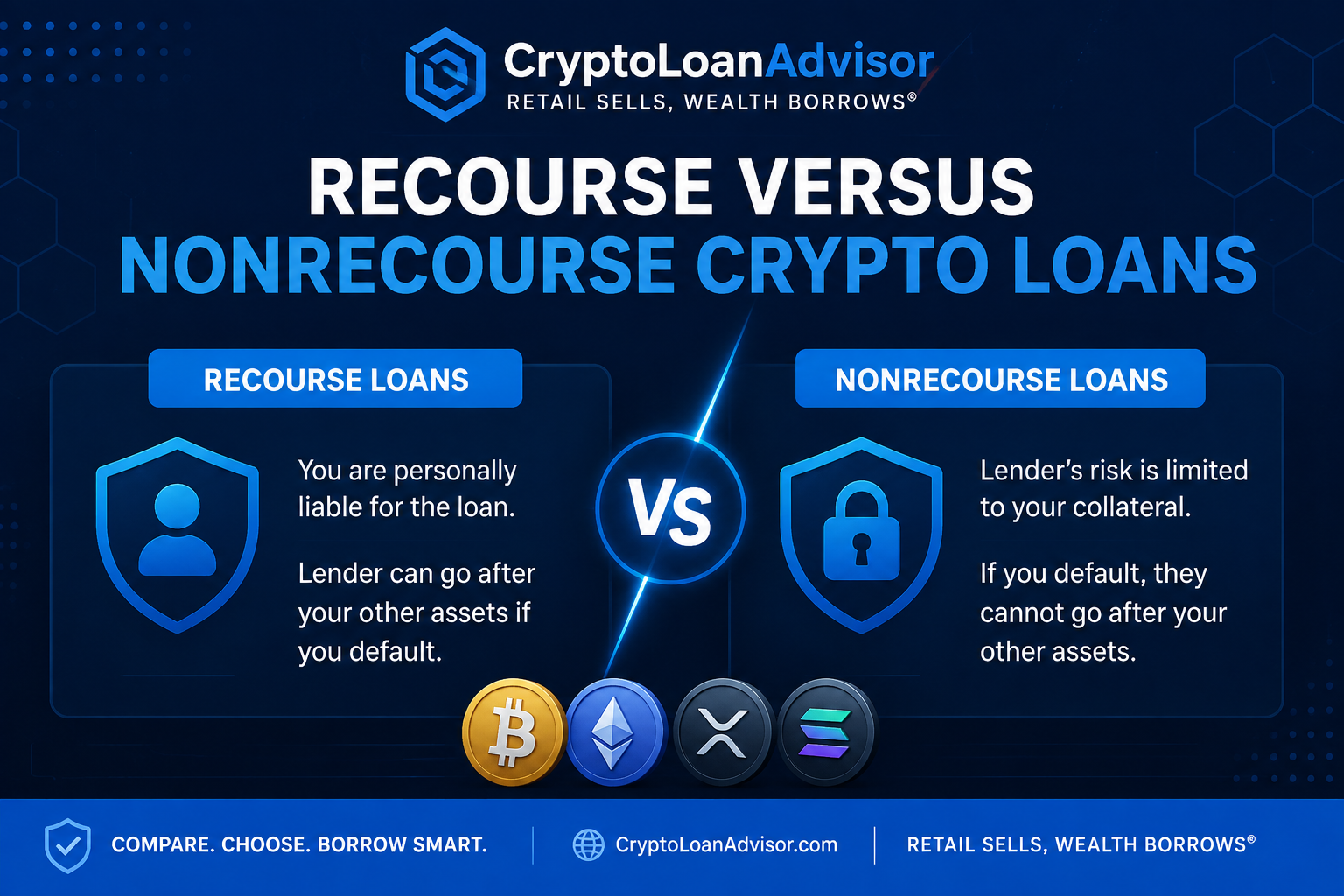
A recourse loan gives the lender the right to pursue the borrower for an unpaid deficiency after collateral is sold or liquidated. If you borrow $100,000 against crypto, the market drops quickly, and the lender liquidates the collateral for only $80,000 after applicable costs, a recourse structure may leave you responsible for the remaining $20,000.
A nonrecourse loan generally limits the lender’s recovery to the pledged collateral. In the same scenario, the lender can take and sell the collateral, but should not have a contractual claim against your other assets for a remaining shortfall.
That is the simple framework. The real-world details are more complicated. A product marketed as “nonrecourse” may still have exceptions for fraud, misrepresentation, prohibited activity, or failure to meet certain contractual obligations. A loan that appears limited to collateral may also use language such as a personal guarantee, indemnity, or setoff right that changes the practical result.
The loan agreement, not the marketing label, controls your exposure.
Why the distinction matters more in crypto
Traditional collateral can decline, but crypto collateral can move 10%, 20%, or more in a short window. A loan that begins at a conservative loan-to-value ratio can become stressed quickly during a broad market selloff.
Loan-to-value, or LTV, is the loan balance divided by the value of your pledged crypto. If you post $200,000 of BTC and borrow $60,000, your starting LTV is 30%. If BTC falls and the collateral value declines to $100,000, that same $60,000 balance is now a 60% LTV.
Most crypto lenders establish at least two important levels: a margin-call threshold and a liquidation threshold. At a margin call, you may need to add collateral, repay part of the loan, or both. At liquidation, the lender may sell pledged assets to bring the LTV back within its required range or close the position entirely.
The risk is not only that you lose assets during a downturn. The risk is that a rapid move, thin liquidity, trading delays, platform downtime, or liquidation fees leave proceeds below the amount due. With recourse, that gap can become a personal obligation. With nonrecourse, the collateral may be your maximum economic loss, assuming the agreement truly limits lender recovery.
Recourse versus nonrecourse crypto loans: the trade-off
Nonrecourse sounds clearly superior because it caps downside beyond the assets pledged. For many investors, that protection is valuable. It creates a defined risk boundary: the borrower can lose the collateral, but a market shock should not reach unrelated assets, income, or future holdings.
That protection can come with a cost. A lender taking more downside risk may offer a lower maximum LTV, charge a higher interest rate, require more valuable collateral, impose stricter liquidation rules, or limit eligible assets. The lender may also reserve broad discretion around collateral management in volatile conditions.
Recourse financing can sometimes support more favorable pricing or capacity because the lender has additional avenues of recovery. It may make sense for a borrower with substantial liquidity, stable income, a diversified balance sheet, and a clear plan to manage LTV. But it also converts a collateralized loan into a potentially broader balance-sheet obligation.
Neither structure is automatically right. A borrower seeking modest liquidity against a concentrated, highly appreciated crypto position may prioritize nonrecourse protection and a lower LTV. An experienced investor borrowing against diversified collateral with ample reserves may decide that a recourse structure’s pricing is worth the added liability. The answer depends on the full agreement and your ability to withstand a severe drawdown.
Do not confuse liquidation with limited liability
Many crypto loan products are designed to liquidate collateral automatically when risk limits are breached. That feature does not, by itself, make a loan nonrecourse.
Automatic liquidation describes the lender’s operational process. Nonrecourse describes the lender’s legal ability to recover losses after that process. A lender can liquidate your collateral and still retain the right to seek a deficiency if the sale proceeds are insufficient.
Ask specifically: if liquidation proceeds do not cover principal, accrued interest, fees, and costs, is the borrower liable for the shortfall? Get the answer in the governing documents. A support-chat response or headline on a pricing page is not a substitute for the loan terms.
Also determine whether liquidation is partial or full. Some platforms sell only enough collateral to restore a target LTV. Others may close the entire loan once the liquidation threshold is reached. Partial liquidation can preserve more upside if the market recovers, but it can also leave a borrower with less collateral and a remaining loan balance during an unstable market.
Terms to examine before you pledge crypto
Read the terms with the mindset of a risk manager, not just a borrower comparing annual percentage rates. Four areas deserve close attention:
- Deficiency liability: Look for recourse, personal liability, personal guarantee, deficiency, indemnification, and setoff language. Ask whether any exception can create liability beyond collateral.
- LTV mechanics: Confirm the starting LTV, margin-call level, liquidation threshold, pricing source, monitoring frequency, cure period, and whether the lender can change parameters.
- Liquidation execution: Understand who controls the sale, whether the lender can liquidate without further notice, what fees apply, and how excess proceeds are returned.
- Custody and counterparty exposure: Determine where collateral is held, whether it is segregated, how security interests are documented, and what could happen if the lender or custodian experiences financial distress.
Interest rates matter, but they are only one part of borrowing cost. Origination fees, withdrawal fees, prepayment rules, late charges, spread on asset sales, and required stablecoin conversions can materially affect the economics. Compare the total expected cost alongside the worst-case collateral outcome.
A practical framework for choosing a structure
Start by deciding how much collateral loss you could tolerate without damaging your broader plan. Do not base that answer on your conviction that Bitcoin or another token will recover. Conviction is not liquidity during a margin call.
Next, stress-test the loan. Model what happens if collateral falls 30%, 50%, and 70% from its value on the day you borrow. Calculate the LTV at each level, estimate when a margin call would occur, and identify cash or additional crypto you could use to respond. If meeting a margin call would require selling assets at the worst possible time, the loan may be too large.
For many holders, a lower starting LTV is more meaningful than the maximum amount a lender is willing to advance. Borrowing 20% to 30% of collateral value may leave more room for volatility than borrowing near a platform’s maximum. It does not eliminate liquidation risk, especially for volatile altcoins, but it gives your strategy more margin for error.
Then compare lender documentation side by side. Focus on whether the loan is explicitly nonrecourse, whether the definition survives a shortfall, and whether exceptions are narrow and understandable. If the terms are unclear, assume the risk is not limited until qualified legal counsel confirms otherwise.
Tax, legal, and borrower-specific considerations
Borrowing against crypto is generally different from selling crypto, but loan proceeds and collateral events can have tax consequences depending on the facts. A liquidation may be treated as a disposition of crypto. Interest deductibility can also depend on how borrowed funds are used and on your personal situation.
Legal treatment varies by state, lender structure, borrower type, and contract language. Business-purpose loans, individual loans, institutional facilities, and decentralized protocols can involve very different rights and protections. DeFi borrowing may be economically similar to a collateralized loan while relying on smart-contract liquidation rather than a traditional lender relationship.
That is why sophisticated borrowing begins with documentation and planning. Consider a tax professional and attorney when the loan size, collateral concentration, or potential deficiency is meaningful. Independent education can help you compare structures, but it cannot replace advice tailored to your balance sheet.
A good crypto loan should create flexibility, not force a decision under pressure. Borrow only against collateral you can afford to manage through volatility, keep a realistic reserve plan, and treat every promise of “nonrecourse” as a term to verify before you transfer a single coin.




