
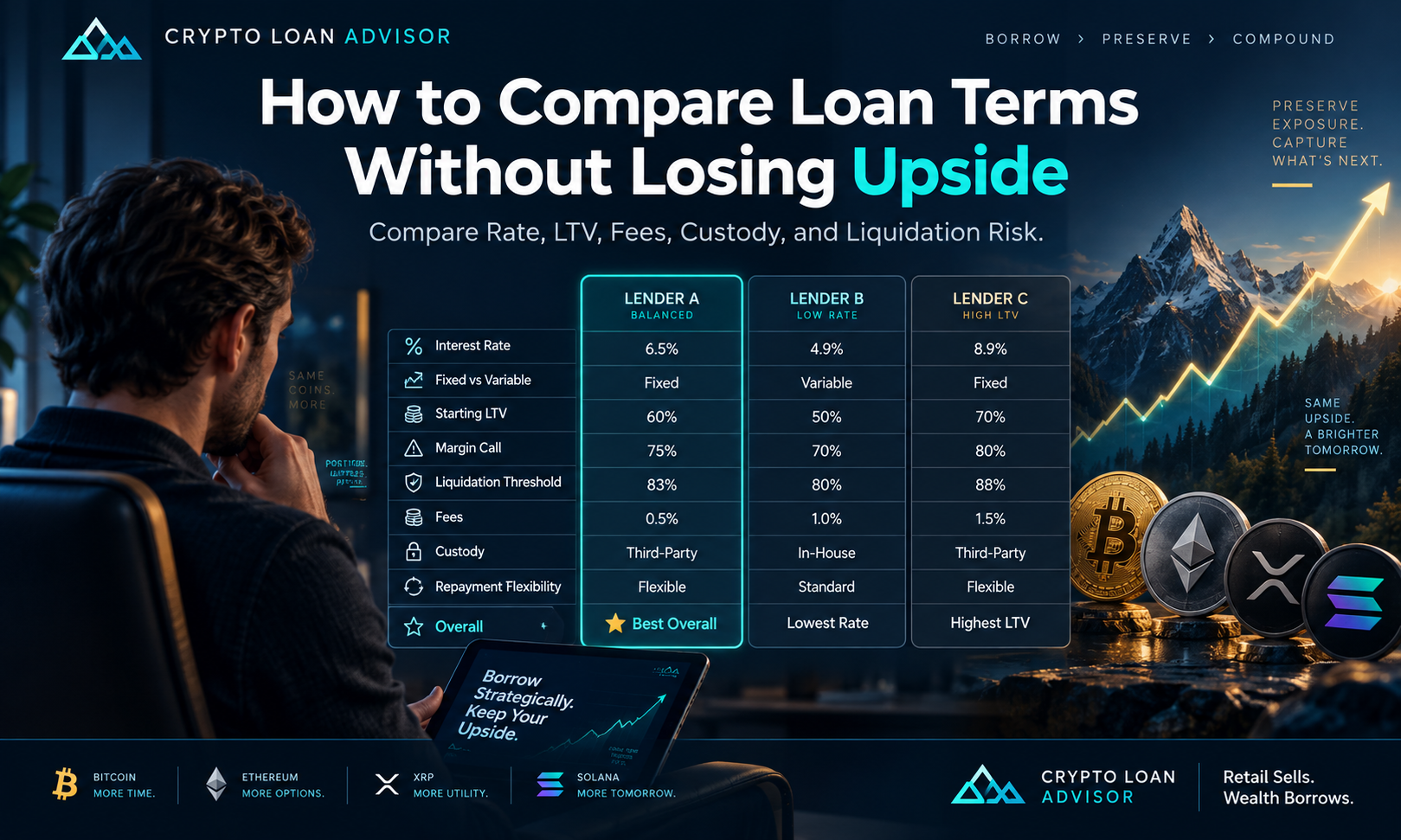
A crypto loan can create liquidity while you keep your Bitcoin, Ethereum, XRP, Solana, or other holdings. But the wrong structure can turn a short-term cash need into a forced sale at the worst possible time. Knowing how to compare loan terms means looking beyond the advertised rate and judging the full risk-and-flexibility package.
Retail sells. Wealth borrows – but only when the borrowing terms protect the assets that made the strategy worthwhile. A lower interest rate may come with tighter loan-to-value limits, a less forgiving liquidation threshold, or collateral arrangements that deserve closer scrutiny. Compare the whole agreement before you move a single token.
Start With the Same Borrowing Scenario
Loan offers are only comparable when the assumptions match. Use the same collateral asset, collateral value, loan amount, and intended repayment period for every lender you review. Otherwise, a headline rate can make one offer look cheaper simply because it assumes a different loan-to-value ratio or a different term.
For example, imagine you hold $100,000 in BTC and want $25,000 in liquidity for six months. That is a 25% starting LTV, calculated as loan balance divided by collateral value. Ask every lender what that exact scenario would cost and what happens if Bitcoin declines by 20%, 30%, or 40%.
This approach puts the decision in investor terms: How much capital can you access, what does it cost, and how much market volatility can your position withstand? A lender that offers more borrowing capacity is not automatically the better fit. Higher initial LTV generally means less room for error.
How to Compare Loan Terms Beyond the Interest Rate
The quoted APR or interest rate matters, but it is only one line of the economic picture. First, confirm whether the rate is fixed or variable. A fixed rate makes borrowing costs easier to forecast. A variable rate may begin lower but can rise during your loan, especially when demand for crypto credit changes.
Next, establish how interest accrues and how it is paid. Some products require monthly cash payments. Others allow interest to accrue and add to the outstanding balance. The second option can preserve cash flow, but your effective LTV may rise even if your collateral price stays flat. That can bring a margin call closer over time.
Then look for fees. Origination fees, administrative charges, withdrawal fees, prepayment penalties, late fees, and collateral transfer costs can materially change the real cost of borrowing. A 9% loan with a sizable origination fee may be more expensive than an 11% loan with no upfront charge, particularly if you plan to repay early.
Ask for the total dollar cost under your expected repayment timeline, not just the annualized percentage. If you expect to repay a loan in 90 days, a lender’s one-year marketing example tells you very little.
Compare APR With the Cost of Staying Invested
Borrowing against crypto is often built around a simple idea: preserve exposure rather than sell an asset you believe may appreciate. That potential upside is real, but it is not guaranteed, and it does not erase borrowing costs.
A useful question is whether the liquidity you receive has a clear purpose. Funding a business expansion, covering a temporary tax obligation, or avoiding a poorly timed asset sale may justify interest expense. Borrowing to increase a speculative position can compound risk. Your loan should improve your financial flexibility, not make your balance sheet dependent on a bullish market.
LTV, Margin Calls, and Liquidation Thresholds Matter Most
For many crypto borrowers, collateral risk is more important than the interest rate. Initial LTV tells you how much you borrow against your deposited assets at origination. Liquidation LTV tells you the point at which the lender may sell collateral to bring the loan back within its limits.
Suppose you deposit $100,000 of ETH and borrow $30,000. Your starting LTV is 30%. If the collateral falls to $60,000 while the loan balance remains $30,000, your LTV rises to 50%. Whether that creates a margin call or liquidation event depends on the lender’s thresholds.
Do not stop at the liquidation number. Find out when the lender sends warnings, whether you can add collateral, whether partial repayment can cure the issue, and how quickly action is required. A platform that provides alerts and reasonable cure options may be easier to manage than one that liquidates quickly with limited notice. Still, no alert system removes the responsibility to monitor your position.
A conservative starting LTV gives you more downside buffer. It also means borrowing less against the same assets. That is the central trade-off: maximum liquidity versus maximum resilience. Long-term holders who value keeping their coins often prioritize resilience.
Model a Downside Case Before You Borrow
Before accepting any offer, calculate your LTV after several price declines. Model at least a 25%, 40%, and 60% drop in collateral value. Crypto has moved through those ranges before, sometimes quickly.
Also consider concentration. A loan backed entirely by one volatile token carries different risk from collateral spread across assets, assuming the lender supports them. Diversification does not prevent losses, but it can change how a drawdown affects a single loan position.
Examine Custody, Control, and Counterparty Risk
When you use crypto as loan collateral, you are evaluating more than a loan agreement. You are also evaluating the entity or structure holding assets that may represent a meaningful part of your wealth.
Confirm whether collateral is held with a qualified custodian, in segregated wallets, in a lending pool, or under another arrangement. Ask whether assets can be rehypothecated, meaning used by the lender or a partner for additional activity. Understand what contractual claim you have if the company experiences financial distress.
Security practices, insurance language, regulatory availability, financial disclosures, and operating history all deserve review. Insurance may have exclusions and limits, so it should not be treated as a blanket guarantee. A polished website and an attractive rate are not substitutes for understanding who holds the collateral and under what terms.
CryptoLoanAdvisor’s independent comparison mindset is especially useful here: separate the marketing promise from the contractual reality. The lender’s role, the custodian’s role, and your rights as a borrower should be clear before assets leave your wallet.
Check Repayment Flexibility and Loan Mechanics
A loan should fit your cash flow, not force a refinancing decision later. Review whether the term is open-ended, fixed for a defined period, or subject to periodic renewal. An open-term loan may offer flexibility, but its rate or conditions may change. A fixed-term loan provides more certainty but can be restrictive if you want to repay early.
Find out whether principal payments are required monthly, whether you can make partial repayments at any time, and whether early repayment carries a penalty. Also verify how collateral is released. If you repay half the principal, can you withdraw a proportional amount of collateral, or must all collateral remain locked until the loan closes?
Operational details matter during volatile markets. Check payment methods, interest due dates, support availability, transfer minimums, and the timing of collateral releases. A loan that looks efficient on paper can be inconvenient if every adjustment requires a lengthy manual process.
Use a Simple Side-by-Side Loan Scorecard
Build a comparison sheet for every offer. Rather than ranking lenders on rate alone, record the figures and policies that affect your actual outcome:
- Interest rate, whether it is fixed or variable, and projected dollar cost for your expected holding period
- Starting LTV, margin-call LTV, liquidation LTV, and the lender’s process for curing a breach
- All upfront, ongoing, repayment, and collateral-transfer fees
- Custody model, rehypothecation policy, security disclosures, and legal structure
- Loan term, repayment rules, early-payoff treatment, and collateral-release process
Give the most weight to the factors that reflect your objective. If your goal is preserving a long-term BTC position through volatility, a lower LTV and a higher liquidation threshold may deserve more weight than a modest rate difference. If you need liquidity for a defined 60-day opportunity, fast funding and no prepayment penalty may matter more.
Choose Terms That Match Your Conviction and Risk Capacity
There is no universally best crypto-backed loan. The right terms depend on your collateral, income, liquidity needs, tax situation, price-risk tolerance, and ability to respond if markets move sharply. A borrower with substantial cash reserves can manage a margin call differently from someone whose entire balance sheet is tied to the collateral.
Be skeptical of any offer that makes borrowing sound effortless or risk-free. Crypto-backed credit is a sophisticated tool, not free money. Borrow only an amount you can realistically repay without relying on a specific token price target, and keep a plan for adding collateral or reducing debt if the market declines.
The strongest loan is not necessarily the largest or cheapest one. It is the one that gives you needed liquidity while leaving enough room to stay in control when the market becomes uncomfortable.




