
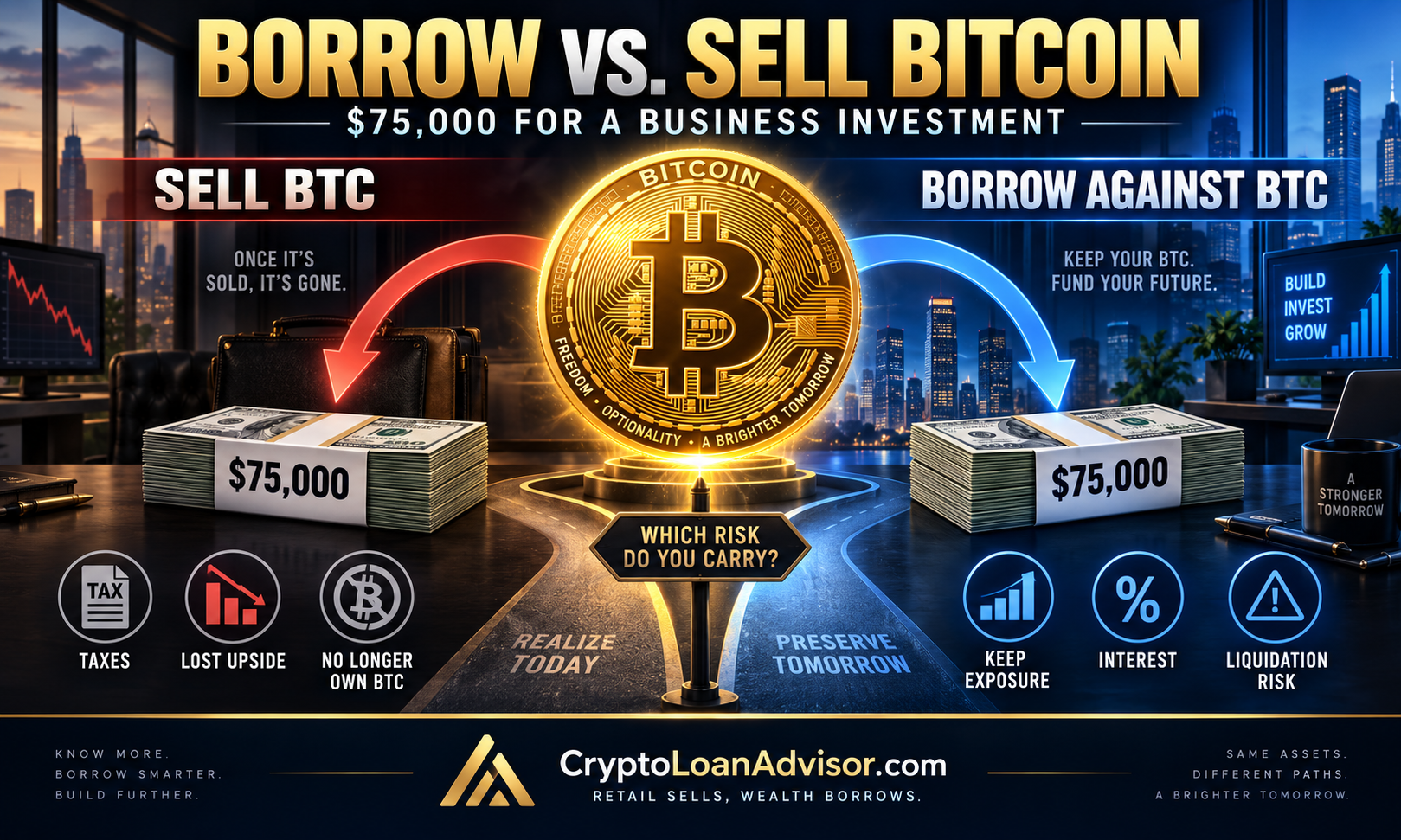
A Bitcoin holder needs $75,000 for a business investment. Selling Bitcoin provides cash with no repayment obligation, but it also ends exposure to any future price appreciation and may create a capital-gains tax bill. Borrowing against Bitcoin preserves ownership, but introduces interest, collateral controls, and the possibility of liquidation. That is the real decision behind crypto borrowing versus asset sales: not whether one option is always better, but which risk you are better positioned to carry.
For long-term digital-asset investors, liquidity is often the challenge. Wealth can be concentrated in assets expected to appreciate, while real-world needs – taxes, property, business capital, or portfolio rebalancing – require dollars. A disciplined choice starts with the cost of selling, then measures it against the cost and risk of borrowing.
Crypto Borrowing Versus Asset Sales: The Core Trade-Off
Selling is simple. You exchange crypto for cash, remove price exposure on the amount sold, and owe no loan payment. If the asset declines after your sale, that decision can look especially strong. The trade-off is permanent: if Bitcoin, Ethereum, XRP, or Solana rises sharply, you no longer participate in that appreciation on the coins you sold.
A crypto-backed loan uses your digital assets as collateral for a loan, typically paid in U.S. dollars, stablecoins, or another supported currency. You retain beneficial economic exposure to the collateral while gaining liquidity. The lender, however, has rights to the pledged collateral under the loan agreement. If collateral value falls enough, you may need to add collateral, repay part of the loan, or face liquidation.
The “Borrow, Don’t Sell” strategy can be powerful for investors with long time horizons and conviction in their holdings. It is not a promise that borrowing creates wealth. It is a financing decision that substitutes one set of risks – opportunity cost and potential taxes from selling – for another – interest expense, lender risk, and downside volatility.
When Selling Crypto May Be the Better Decision
Asset sales are often underestimated because they lack the sophistication of a collateralized loan. Yet simplicity has value. Selling may be the stronger choice when the required cash need is permanent, repayment would strain your budget, or you no longer want the same level of crypto exposure.
Consider a holder who needs funds for a down payment and has no predictable income to service a loan. Borrowing could preserve crypto upside, but it could also turn a housing goal into a collateral-management problem during a market drawdown. A sale may be less exciting, but it removes the prospect of margin calls at the wrong moment.
Selling can also make sense when you are deliberately reducing concentration. If 70% of your net worth is tied to one token, borrowing against that token does not diversify your balance sheet. It may deepen your dependence on a single asset’s price. A partial sale can fund a goal while reducing portfolio risk.
Taxes matter, but they should not make the decision alone. In the United States, selling appreciated crypto generally creates a taxable capital gain. The actual treatment depends on holding period, cost basis, income, state residency, and transaction history. A tax professional can help model the liability before you trade. Paying tax is not automatically a reason to avoid a sale, particularly if selling meaningfully improves your financial resilience.
When Crypto Borrowing Can Create More Flexibility
Borrowing is most compelling when an investor has a temporary liquidity need, a clear repayment source, and a strong reason to maintain exposure to the pledged asset. An entrepreneur may need working capital before a receivable arrives. A high-income professional may want to cover a short-term obligation without disrupting a long-term Bitcoin position. A holder may also prefer to avoid selling in a depressed market if their financial position can withstand further volatility.
Loan proceeds are generally not treated as taxable income simply because you borrowed money. That can make borrowing useful for accessing liquidity without triggering a sale at the time of funding. Still, the details matter. Collateral transfers, liquidations, interest treatment, and platform-specific mechanics can have tax consequences. Do not assume a loan is tax-neutral in every outcome.
Borrowing also preserves optionality. You can repay and reclaim collateral if the strategy works as planned. A sale cannot be reversed without buying back the asset, potentially at a much higher price and with a different tax basis. That optionality is valuable, but only if the loan terms leave you enough room to manage volatility.
Loan-to-value is your safety margin
Loan-to-value, or LTV, is the loan amount divided by the value of pledged collateral. If you borrow $25,000 against $100,000 of Bitcoin, your starting LTV is 25%.
Lower LTV generally provides a larger cushion against a decline in collateral value. At a 25% starting LTV, the asset can fall substantially before the loan reaches a high-risk zone. At a 60% or 70% starting LTV, a normal crypto drawdown can quickly become a margin-call event.
The maximum LTV a lender advertises is not necessarily the LTV you should use. Sophisticated borrowing often means borrowing less than you qualify for. Your objective is not to extract every available dollar. It is to obtain useful liquidity while preserving the ability to survive unfavorable markets.
Interest is a real cost, even when the asset rises
A loan is not free because your crypto appreciates. Interest accrues based on the loan terms, which may include fixed or variable rates, origination fees, servicing charges, and penalties for late payment. Some products require monthly interest payments, while others may allow interest to accrue. The right structure depends on your cash flow, not just the headline annual percentage rate.
Before borrowing, calculate the total expected cost for the period you realistically expect to hold the loan. Then consider a less comfortable scenario: what happens if you need the loan for twice as long, or if your income falls? A strategy that works only under perfect timing is not a durable strategy.
Compare the Risks You Actually Own
The cleanest way to evaluate crypto borrowing versus asset sales is to compare outcomes across several plausible market conditions, not just a bullish forecast.
If you sell and the asset rises, you experience opportunity cost. If you borrow and the asset rises, you keep exposure but pay interest. If you sell and the asset falls, you avoid further losses on what you sold. If you borrow and the asset falls, the loan can become more dangerous precisely when you may least want to sell.
Lender risk deserves equal attention. A crypto-backed loan is not merely a rate comparison. Review who holds the collateral, whether assets are segregated, the legal structure of the arrangement, withdrawal and repayment procedures, collateral monitoring, margin-call notices, liquidation thresholds, and the provider’s track record. CryptoLoanAdvisor’s independent approach begins with this principle: understand the agreement before assets leave your control.
Do not confuse a margin call with a guaranteed opportunity to act. In fast markets, collateral values can move rapidly. Some lenders may notify you at a specified LTV and liquidate at a higher threshold, but the timeline, communication process, and ability to add collateral vary by provider. Read the actual terms rather than relying on a simplified marketing example.
A Practical Decision Framework
Start with the purpose of the cash. Is it funding an expense that produces value, such as business inventory or a planned investment, or is it supporting lifestyle spending? Borrowing against volatile assets for consumption can place long-term holdings at risk without creating a corresponding asset or income stream.
Next, identify your repayment source. “Crypto will go up” is not a repayment plan. Reliable income, business revenue, or a defined liquidity event is stronger. If repayment depends entirely on appreciation, you are effectively increasing the pressure on a volatile position.
Then stress-test the collateral. Ask whether you could handle a 30%, 50%, or deeper decline without panic-selling, adding collateral you do not have, or missing required payments. Crypto markets have a history of fast, severe drawdowns. Build your decision around that reality.
Finally, compare the after-tax cost of selling with the all-in cost of borrowing. Include estimated capital gains taxes, interest, fees, and the financial impact of a potential liquidation. The answer may favor a partial sale, a conservatively sized loan, or a combination of both. For example, selling enough to cover taxes and near-term needs while borrowing modestly for a short-term opportunity can reduce pressure on the collateral position.
Borrow With a Plan, Not Just Conviction
High-conviction holders are right to recognize that selling an appreciating asset can be expensive. But conviction without liquidity discipline can become overexposure. The strongest borrowing decisions pair long-term belief with conservative LTV, clear repayment capacity, carefully reviewed lender terms, and a preplanned response if the market falls.
Your crypto can be a source of liquidity without automatically becoming an asset you must sell. Make the choice that protects both your immediate objective and your ability to stay invested on terms you can realistically manage.




