
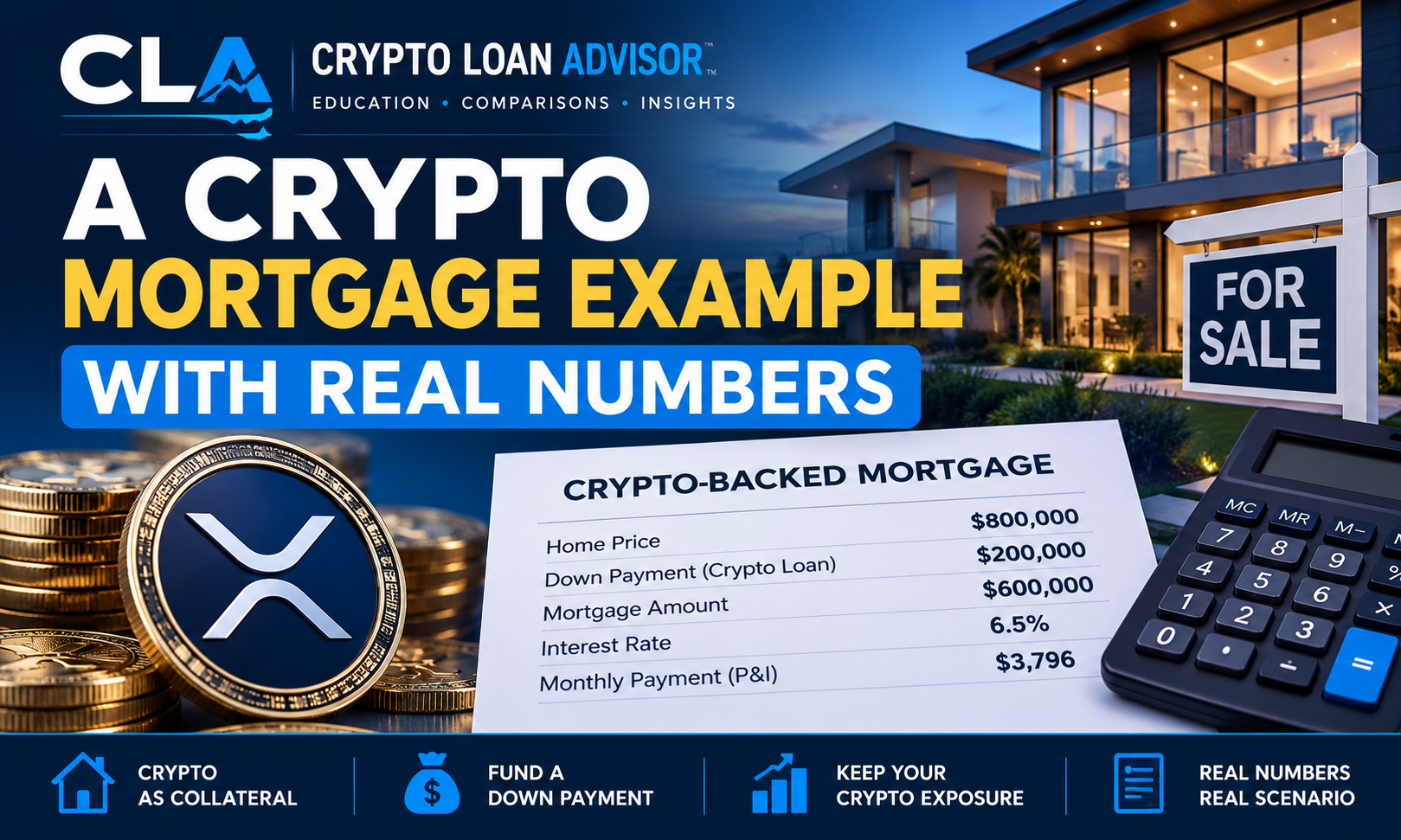
A crypto mortgage example is most useful when it shows more than the upside. Borrowing against Bitcoin or other digital assets may help a long-term holder create home-buying liquidity without selling, but it also layers crypto-market risk onto one of life’s largest financial commitments. The numbers, lender terms, and your ability to handle a sharp drawdown all matter.
For investors who believe in the long-term value of their holdings, the appeal is obvious: sell crypto to fund a down payment, and you may lose future appreciation and potentially create a taxable transaction. Borrow against it, and you retain ownership. Retail sells. Wealth borrows. But wealth also protects its downside before it borrows.
First, What Does “Crypto Mortgage” Actually Mean?
The phrase “crypto mortgage” can describe several different arrangements, and they are not interchangeable.
In the most common structure, a borrower takes a conventional mortgage secured by the home and separately uses a crypto-backed loan to help fund a down payment, closing costs, renovations, or other liquidity needs. The crypto loan is secured by digital assets, not by the house.
Some providers may offer financing where crypto assets play a larger role in the home purchase. Others offer a crypto-backed loan whose cash proceeds can be used to buy a property outright. That is not a traditional mortgage, even if the borrower uses it for a home purchase. The distinction matters because underwriting, consumer protections, interest rates, repayment schedules, collateral custody, and default consequences can be very different.
The example below uses the first structure: a conventional mortgage plus a Bitcoin-backed loan for the down payment. It is hypothetical, and its purpose is to show the mechanics and the pressure points.
Crypto Mortgage Example: Buying a $750,000 Home
Assume an investor wants to buy a $750,000 primary residence. They hold Bitcoin worth $600,000 and do not want to sell it. Their income and credit support a conventional mortgage, and the mortgage lender permits a properly disclosed source of funds for the down payment.
The buyer makes a 30% down payment of $225,000 and takes a conventional mortgage for $525,000. Instead of selling Bitcoin to produce the $225,000, they obtain a crypto-backed loan for that amount.
Here are the working assumptions:
- Bitcoin price at origination: $80,000
- Bitcoin pledged as collateral: 7.5 BTC, worth $600,000
- Crypto-backed loan amount: $225,000
- Starting crypto loan-to-value ratio: 37.5%
- Crypto loan rate: 10% annual interest, interest-only
- Conventional mortgage: $525,000, 30-year fixed rate at 6.5%
- Illustrative margin-call threshold: 60% crypto loan-to-value
- Illustrative liquidation threshold: 70% crypto loan-to-value
The crypto loan’s initial LTV is calculated by dividing the loan balance by collateral value: $225,000 divided by $600,000 equals 37.5%. That relatively conservative starting LTV gives the borrower room for Bitcoin volatility. It does not eliminate the risk.
At 10% interest-only, the crypto loan costs about $1,875 per month in interest. The conventional mortgage’s principal-and-interest payment is roughly $3,318 per month. Combined, the borrower is paying about $5,193 monthly before property taxes, homeowners insurance, maintenance, association dues, crypto-loan fees, and any required mortgage insurance.
That payment stack is the first reality check. A crypto-backed down payment does not make a home less expensive. It changes the source of capital and preserves the borrower’s market exposure to Bitcoin.
What Happens if Bitcoin Falls?
Suppose Bitcoin falls 40%, from $80,000 to $48,000. The pledged 7.5 BTC is now worth $360,000. The crypto loan balance remains $225,000 if the borrower has only made interest payments.
The crypto loan LTV has risen to 62.5%: $225,000 divided by $360,000. Under the illustrative terms, that is above the 60% margin-call threshold. The lender may require the borrower to add collateral, repay part of the loan, or do both within a short period.
To return the LTV to 60%, the borrower could reduce the balance to $216,000, requiring a $9,000 repayment. They could also add enough eligible collateral to bring the ratio back into compliance. The exact cure period and accepted collateral depend on the provider’s agreement.
If Bitcoin falls further, the situation becomes more serious. At a 70% liquidation threshold, the collateral value supporting a $225,000 loan cannot drop below roughly $321,429. With 7.5 BTC pledged, that corresponds to a Bitcoin price of about $42,857.
If the borrower cannot respond before liquidation, the provider may sell some or all of the pledged Bitcoin. That can permanently reduce the investor’s exposure just when they may be least willing to sell. Depending on the transaction and jurisdiction, a forced sale may also have tax consequences. A tax professional can address the borrower’s specific situation.
What Happens if Bitcoin Rises?
Now consider the more favorable outcome. If Bitcoin rises from $80,000 to $120,000, the collateral value grows from $600,000 to $900,000. With the same $225,000 loan balance, the LTV drops to 25%.
The borrower has retained Bitcoin exposure while using loan proceeds to support the home purchase. They may have more flexibility to refinance, repay the crypto loan, or withdraw excess collateral if the lender allows it. Yet appreciation does not turn a costly loan into free money. The interest expense continues, and a later correction can still change the picture quickly.
The Conventional Mortgage Lender Still Matters
A major mistake is assuming that a crypto-backed loan automatically works as a down payment source. Conventional mortgage lenders generally review the source of funds, the borrower’s liabilities, payment obligations, and ability to repay. A borrowed down payment can affect underwriting, and lender policies vary.
The buyer should disclose the crypto loan early. Hiding a new obligation can create problems during underwriting and closing. The mortgage lender may require account statements, loan documents, evidence of the funds’ transfer path, and proof that the borrower can carry both payments.
There is also a timing issue. Crypto markets move continuously, while home closings operate on deadlines. If a collateral call arrives days before closing, the borrower may need cash or additional crypto immediately. A home transaction is not the place to discover that a lender’s collateral transfer, stablecoin conversion, or bank withdrawal process takes longer than expected.
When This Strategy Can Fit – and When It Usually Does Not
A crypto-backed home-buying strategy may fit an investor with substantial collateral beyond the amount pledged, stable income, significant cash reserves, and a genuinely long-term conviction in their assets. Starting at a lower LTV can provide a meaningful cushion. So can holding a separate reserve in cash or highly liquid assets specifically for margin calls and loan payments.
It is usually a poor fit for someone using most of their crypto portfolio as collateral, stretching to qualify for the home, or relying on continued price appreciation to make the math work. If a 30% to 50% crypto decline would force the borrower to sell assets, miss payments, or jeopardize the home purchase, the structure is too aggressive.
The cost comparison also deserves honesty. A borrower may avoid selling today, but they are paying interest to do so. The strategy works only if preserving exposure, financial flexibility, and potential tax planning outweigh the borrowing cost and risk for that individual.
Questions to Ask Before Using Crypto for a Home Purchase
Before choosing a provider, compare the loan structure rather than focusing only on the advertised interest rate. Ask how LTV is calculated, when collateral is revalued, what triggers a margin call, how much time you have to cure it, and whether the lender can liquidate automatically.
Also ask who holds the collateral, whether the assets are rehypothecated, what happens if the platform experiences operational stress, and whether repayment can be made at any time without a penalty. Confirm whether interest is paid in dollars, stablecoins, or crypto, and account for conversion fees and withdrawal limits.
Finally, run a stress test before you apply. Model Bitcoin or Ethereum down 50%, calculate your combined housing and crypto-loan payments, and identify exactly where the cash to meet a collateral call would come from. If that answer depends on selling during a downturn, the loan amount should likely be lower.
A home can be a long-term asset, and so can a high-conviction crypto position. The disciplined approach is not to borrow the maximum available amount. It is to borrow only what lets you keep both commitments through the market conditions you cannot predict.




