
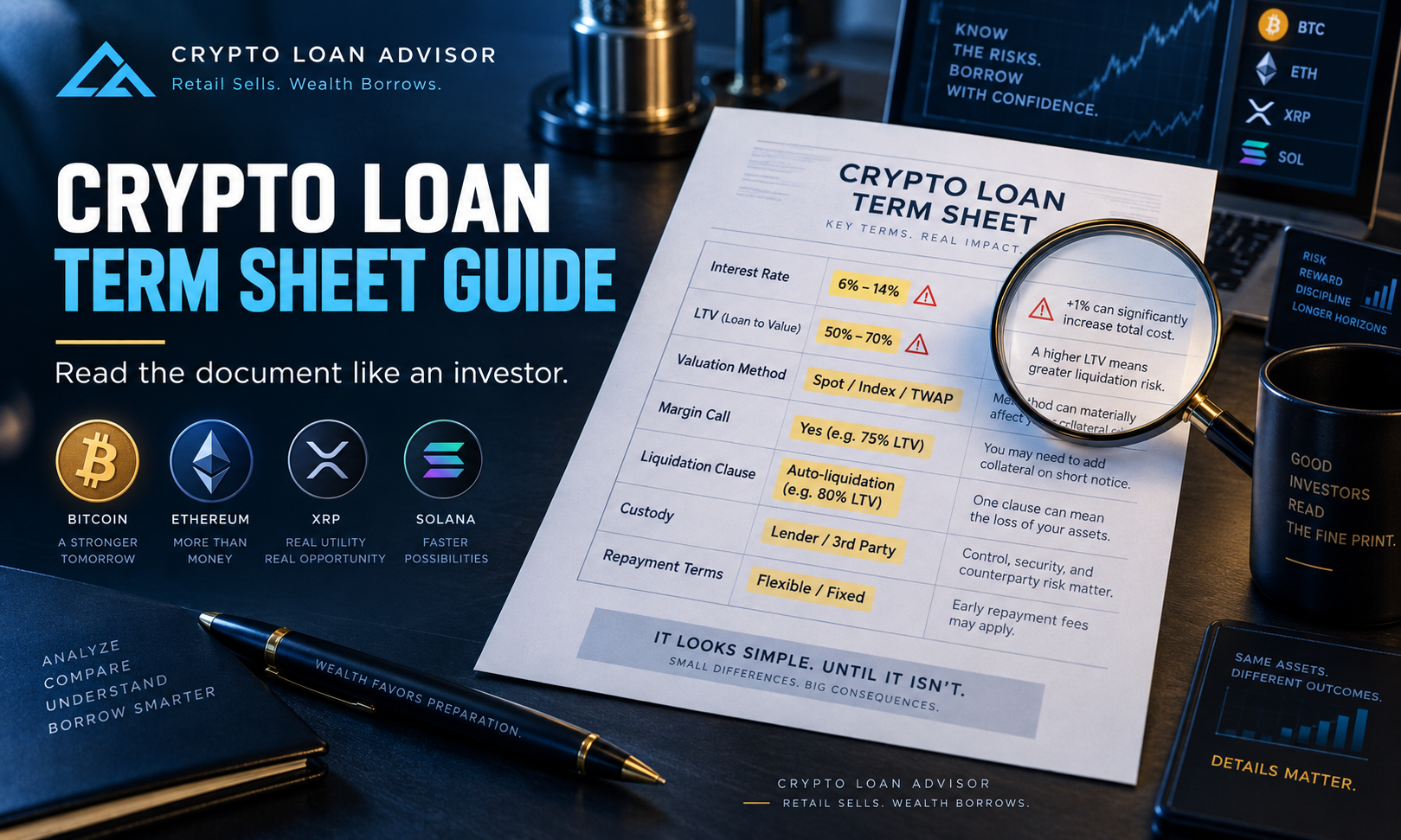
A crypto loan term sheet can look straightforward until you realize one percentage point, one valuation rule, or one liquidation clause can materially change the risk of borrowing against your Bitcoin, XRP, Ethereum, or Solana. The purpose of this crypto loan term sheet guide is to help you read the document as an investor, not just as someone looking for fast liquidity.
Borrowing against digital assets can preserve ownership and avoid a sale that may end your upside exposure or create a taxable event. But the strategy only works when the loan structure fits your cash flow, risk tolerance, and view of the market. A term sheet is where that structure becomes real.
What a Crypto Loan Term Sheet Actually Tells You
A term sheet is a preliminary summary of a proposed loan’s commercial terms. It is not always the final loan agreement, and some provisions may be nonbinding. Still, it tells you what you are being asked to accept before you transfer collateral or sign definitive documents.
Think of it as the operating manual for your borrowing relationship. It should identify the borrower and lender, the assets you will pledge, the amount you can borrow, pricing, repayment expectations, custody arrangements, and the lender’s rights if the value of your collateral falls.
Do not treat a term sheet as marketing copy. A promotional rate may be real, but it may apply only to a certain loan-to-value ratio, token, term length, payment method, or borrower profile. The details around that headline number often matter more than the headline itself.
Start With the Loan-to-Value Ratio
Loan-to-value, or LTV, is the percentage of your collateral’s current value that you borrow. If you post $100,000 of Bitcoin and receive $30,000, your starting LTV is 30%.
A lower LTV generally gives you more room before a margin call or liquidation event. It also means you must pledge more assets for the same amount of cash. A higher LTV can increase available liquidity, but it leaves less room for crypto’s routine price swings.
Your term sheet should state the initial LTV, maximum LTV, and the method used to value collateral. Ask whether the lender uses a single exchange, a benchmark index, a volume-weighted price, or its own pricing source. Valuation frequency matters too. A lender that monitors collateral continuously can react more quickly during a sharp overnight move than one that values it daily.
The useful question is not simply, “How much can I borrow?” Ask, “How far can my collateral fall before I must add assets or repay principal?” That is your actual safety margin.
A simple collateral stress test
Suppose you deposit $100,000 in ETH and borrow $25,000. Your starting LTV is 25%. If ETH falls 30%, your collateral is worth $70,000 and your LTV rises to about 35.7%.
Whether that is manageable depends on the margin-call and liquidation thresholds in your term sheet. If a margin call begins at 40% and liquidation starts at 50%, you still have room. If the lender’s limits are 35% and 40%, the same market decline creates an immediate operational problem.
Run this exercise at 20%, 35%, 50%, and 65% collateral declines. Crypto markets can move beyond what feels likely, especially when liquidity thins. Borrowing conservatively is not pessimism. It is how long-term holders keep temporary volatility from forcing a permanent sale.
Read Margin Call and Liquidation Terms Word by Word
Margin calls and liquidation provisions deserve more attention than the interest rate. A low-rate loan is not attractive if a modest drawdown could cause your lender to sell assets you intended to hold for years.
A margin call is typically a notice that your LTV has risen above a specified threshold. The lender may require you to add collateral, repay part of the loan, or do both. The term sheet should identify the cure period: how long you have to act after notice is delivered.
That timeframe can range from days to hours. It may also depend on whether the lender considers the market unusually volatile. Find out how notices are sent, whether notices occur outside business hours, and whether you can make a partial payment to cure the breach.
Liquidation is what happens if you do not cure, or if LTV reaches a higher threshold. Review whether liquidation is automatic, discretionary, partial, or total. Some lenders may sell enough collateral to bring the loan back within limits. Others may have broader rights to sell collateral quickly, particularly if market conditions deteriorate.
Also look for liquidation fees, trading spreads, and any language allowing the lender to use its own execution process. Your collateral can be sold at a price that differs from the quote you see on a consumer exchange. That difference matters most when markets are moving fast.
Understand the Real Cost of the Loan
The stated annual percentage rate is only one component of borrowing cost. A crypto loan term sheet should explain whether interest is fixed or variable, how it accrues, when it is paid, and what happens if you pay early.
With simple interest, the calculation is generally based on principal. With compounding interest, unpaid interest can itself accrue interest. Some loans require monthly interest payments and a balloon principal repayment at maturity. Others may allow interest to accrue until the end of the term. The latter can improve near-term cash flow, but it increases the balance you must repay later.
Review every fee alongside the stated rate. Common items include origination fees, administrative fees, collateral transfer costs, late-payment charges, liquidation fees, and wire fees. If a lender deducts an origination fee from the proceeds, your usable cash may be lower than the stated loan amount.
For example, a $50,000 loan with a 2% origination fee gives you $49,000 before any other costs. Compare offers based on the cash you receive, total dollars repaid, collateral requirements, and downside protections, not rate alone.
Confirm What Happens to Your Crypto Collateral
Collateral custody is a core risk consideration. A term sheet should clarify whether assets are held in segregated wallets, omnibus wallets, qualified custody arrangements, or another structure. It should also state whether the lender may rehypothecate, lend, stake, trade, or otherwise use your collateral.
Rehypothecation means a lender may use pledged assets in its own financing or trading activities, subject to the agreement. It can support certain lending models, but it introduces counterparty and operational risk. If your priority is asset isolation, look closely at whether the terms provide that protection rather than assuming it exists.
Ask what occurs if the lender experiences financial distress, a cybersecurity incident, or a dispute over ownership. The answer may be governed by the final loan agreement rather than the term sheet, but the term sheet should point toward the relevant custody and security provisions.
A lender’s collateral policy is not just a technical detail. When you borrow, you are evaluating both the loan and the institution holding your assets.
Match the Repayment Structure to Your Liquidity Plan
Term length and repayment design should match the reason you are borrowing. Using a short-term crypto-backed loan for a predictable, near-term business expense is different from funding a multiyear investment with no certain cash flow.
Check the maturity date, payment schedule, prepayment rights, and extension options. Some loans are callable, meaning the lender may demand repayment under circumstances defined in the agreement. Others may renew automatically or offer renewal only at the lender’s discretion and at then-current rates.
If your repayment plan depends on selling crypto at a future price, be honest about the risk. That is not necessarily wrong, but it creates a second market-timing decision. A stronger structure usually includes a repayment source outside the pledged collateral, such as salary, business revenue, cash reserves, or a planned liquidity event.
Review the Fine Print That Changes Control
Several less-visible provisions can shape your experience as much as the financial terms. Look for governing law, dispute resolution, default definitions, lender assignment rights, borrower representations, tax responsibilities, and reporting obligations.
Pay particular attention to events of default. Missing a payment is an obvious example, but default may also include inaccurate representations, bankruptcy, legal restrictions, failure to maintain an account, or a material adverse change clause. Broad default language gives the lender more discretion when conditions become difficult.
If the loan is made through an entity rather than personally, confirm who provides guarantees and who has authority to act. Entrepreneurs should separate personal and business obligations clearly before pledging long-held digital assets.
A Better Way to Compare Crypto Loan Term Sheets
When reviewing multiple offers, put the terms side by side using the same assumed collateral value and loan amount. Compare starting LTV, margin-call threshold, liquidation threshold, cure period, interest rate, fees, repayment schedule, custody structure, and prepayment terms.
The best offer is rarely the one with the largest loan amount. For many high-conviction holders, the better fit is the structure that provides necessary liquidity while leaving meaningful room for volatility. Retail sells under pressure. Wealth plans for it.
CryptoLoanAdvisor’s educational-first approach begins with this distinction: borrowing against assets is a wealth-management decision, not merely a lending transaction. Independent comparison matters because a term sheet should serve your strategy, not a lender’s volume target.
Before signing, calculate your downside thresholds, confirm where collateral will sit, and decide how you would respond to a 50% market decline before one occurs. A well-read term sheet does not eliminate crypto risk, but it can keep you in control when the market tests your conviction.




