
A Bitcoin holder sees a home they want, but selling a long-held position to make the down payment feels costly. The investor may lose future upside, trigger capital gains, and reduce the portfolio they worked to build. So, can crypto loans fund homes? Yes, in some cases, but the structure matters far more than the headline.
Crypto-backed borrowing can provide liquidity for a down payment, a cash purchase, closing costs, or post-purchase renovations without requiring an immediate sale of Bitcoin, Ethereum, XRP, Solana, or another eligible asset. It is not, however, a simple replacement for a conventional mortgage. The home purchase has a fixed deadline. Crypto collateral can move sharply before that deadline or long after the keys are in your hand.
Retail sells under pressure. Wealth borrows with a plan. For a home purchase, that plan needs to account for lender underwriting, loan-to-value ratios, liquidation thresholds, cash-flow capacity, and the possibility that crypto prices fall when you need flexibility most.
Can Crypto Loans Fund Homes in Practice?
A crypto loan is usually secured by digital assets rather than by the property you are buying. You pledge eligible crypto as collateral, receive U.S. dollars or stablecoins, and use the proceeds for a permitted purpose. Depending on the provider and loan structure, that purpose may include a house down payment, a full cash purchase, or liquidity that supports a broader real-estate transaction.
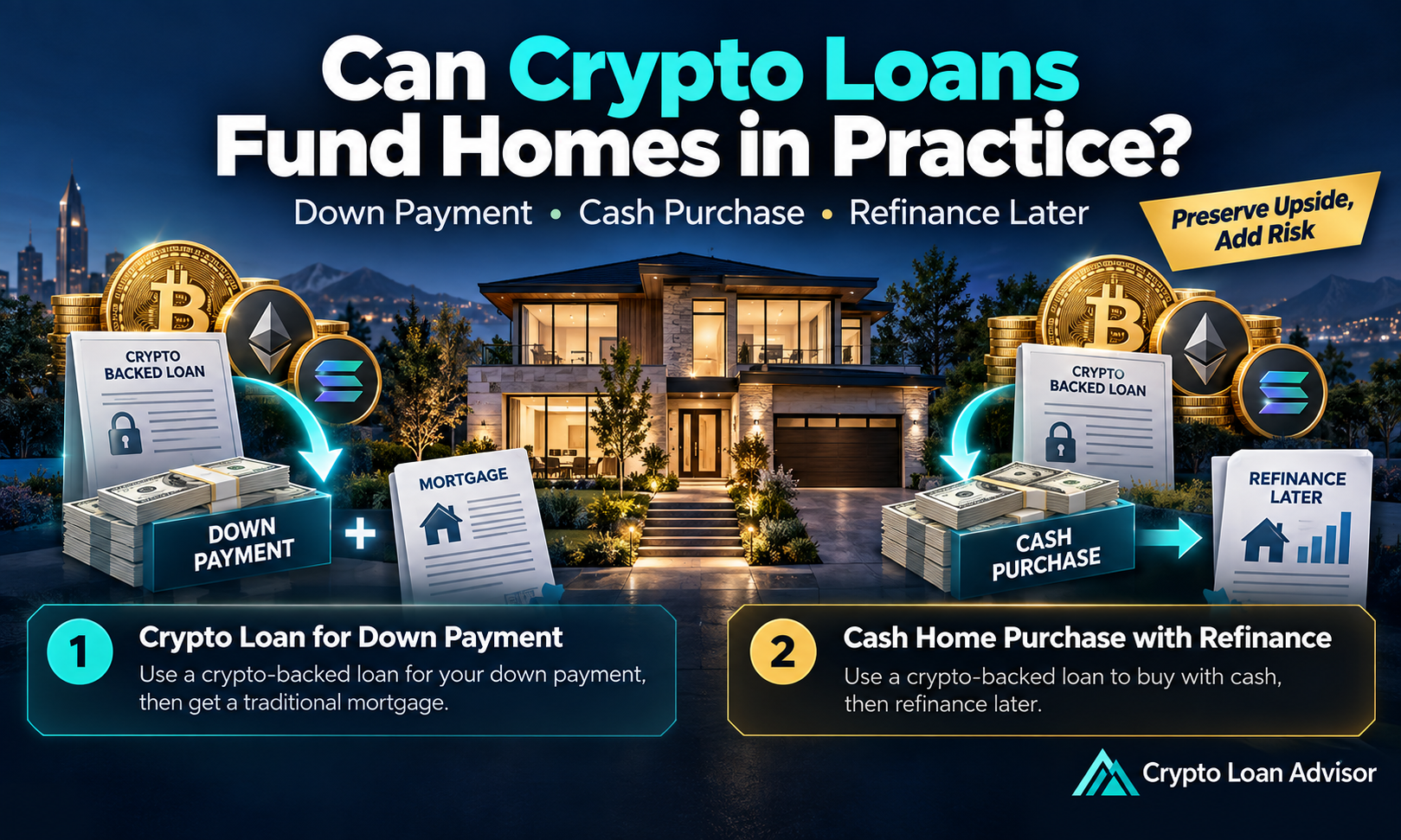
There are two common paths. The first is using a crypto-backed loan to fund a down payment while taking out a conventional mortgage for the rest. The second is borrowing against crypto to buy the home with cash, then refinancing the property later with a traditional mortgage if that fits your financial plan.
Neither approach guarantees mortgage approval. A mortgage lender evaluates income, employment, credit, debt-to-income ratio, assets, and the source of your funds. They may request documentation showing where the crypto collateral came from, how it moved through exchanges or wallets, and how loan proceeds reached your bank account. Rules and underwriting practices differ by lender, so ask before moving funds, not during the final week before closing.
A crypto loan can also increase your monthly obligations. Even if its proceeds become the down payment, the crypto loan payment may count in your debt picture. That can reduce the mortgage amount you qualify for or complicate a lender’s underwriting review.
The Core Trade-Off: Preserve Upside, Add Risk
The appeal is straightforward. Selling appreciated crypto can create a taxable event and permanently reduce exposure to an asset you believe will rise over time. Borrowing may let you retain ownership while accessing spending power today.
But retained upside comes with retained downside. When your digital assets secure a loan, a declining market does not just lower portfolio value. It can create a collateral-management problem. If the value of pledged assets falls below the lender’s required level, you may need to add collateral, repay part of the loan, or face forced liquidation.
That is the central question: are you borrowing against an asset you can afford to see fall substantially while the loan remains outstanding? If the answer is no, funding a home with crypto collateral can turn a wealth strategy into a liquidity crisis.
A simple LTV example
Assume you pledge $400,000 of Bitcoin and borrow $100,000 for a down payment. Your starting loan-to-value ratio, or LTV, is 25%. That is generally more conservative than borrowing near a lender’s maximum LTV.
If Bitcoin falls 50%, your collateral value drops to $200,000. Your $100,000 loan has not changed, so LTV rises to 50%. Whether that triggers action depends on the lender’s margin-call and liquidation rules. A borrower who began at a high LTV could face a call much sooner, possibly at the exact time mortgage payments, moving costs, and home repairs are competing for cash.
A lower starting LTV is not a prediction about the market. It is a cushion for being wrong about the market.
When a Crypto Loan May Fit a Home Purchase
Crypto-backed liquidity is most defensible when it supports a purchase you could sustain even through a prolonged crypto drawdown. That usually means the borrower has reliable income or other liquid reserves, uses a conservative LTV, and understands the loan agreement in detail.
It may fit an investor who needs short-term liquidity for a down payment and expects to repay from documented income, a business distribution, the sale of another asset, or a planned mortgage refinance. It can also be useful for a buyer who wants the negotiating strength of a cash offer but has a credible, low-risk path to refinance the home afterward.
The strategy is less compelling when the entire purchase depends on crypto continuing to rise. A house is illiquid and expensive to maintain. Property taxes, insurance, repairs, HOA fees, and mortgage payments do not pause because the collateral market is down.
Be especially cautious if the crypto loan funds both the down payment and the reserves needed to qualify for or maintain the property. Cash reserves are meant to absorb surprises. Borrowed reserves often amplify them.
Compare the Terms That Can Change the Outcome
Interest rate matters, but it is not the only number that determines whether a crypto loan is appropriate. Before pledging collateral, compare the mechanics that govern your position after funding.
Focus on four areas:
- Starting and maximum LTV: Know the percentage you are borrowing against the collateral and how much price volatility your starting ratio can withstand.
- Margin-call and liquidation thresholds: Ask exactly when the lender notifies you, what remedies are available, and when it can sell your assets.
- Loan cost and repayment structure: Review interest rate, origination fees, prepayment terms, payment frequency, and whether interest can be paid from loan proceeds.
- Custody and lender risk: Determine who controls the assets, whether collateral is segregated, what insurance applies if any, and what happens if the provider experiences financial distress.
A low advertised rate can be less valuable than flexible collateral-management terms. Likewise, a generous maximum LTV is not necessarily a benefit. For a home purchase, borrowing less than the maximum can be the more sophisticated move.
Tax and Mortgage Documentation Deserve Attention
Borrowing against crypto is generally different from selling it. A loan itself typically does not create a capital gain because you have not disposed of the asset. However, liquidation of collateral may create a taxable sale, potentially at an unfavorable time and price.
Your transaction trail also matters. Mortgage lenders and closing agents may need to verify funds under anti-money-laundering procedures. Keep clear records of wallet ownership, exchange statements, loan agreements, wire transfers, and bank deposits. Avoid moving funds through multiple platforms without a clear paper trail shortly before closing.
Tax treatment and mortgage underwriting are fact-specific. A qualified tax professional and an experienced mortgage professional can help identify issues before you make a nonrefundable offer or transfer collateral to a provider.
A Better Decision Framework Before You Borrow
Start with the property, not the crypto. Calculate the full monthly cost of ownership using a realistic mortgage rate, taxes, insurance, maintenance, and any HOA dues. Then add the crypto loan’s required payment and test the result against your stable income and cash reserves.
Next, stress-test your collateral. Model a 30%, 50%, and 70% decline in the pledged assets. For each scenario, calculate your resulting LTV, the amount of collateral you would need to add, and whether you could repay principal without selling at a loss. If one adverse scenario would force a rushed sale of crypto or jeopardize housing payments, reduce the loan amount or reconsider the structure.
Finally, separate conviction from capacity. You may be highly confident in Bitcoin or Ethereum over five years. A lender’s liquidation threshold can operate in hours or days. Long-term conviction does not eliminate short-term collateral risk.
CryptoLoanAdvisor’s investor-first view is simple: compare borrowing options before you commit assets, and treat loan terms as seriously as the home’s purchase contract. Borrowing can preserve optionality, but only if you still control the outcome when markets become volatile.
A home can be a long-term wealth decision. If crypto helps fund it, make sure the financing is built to survive the short term.




