
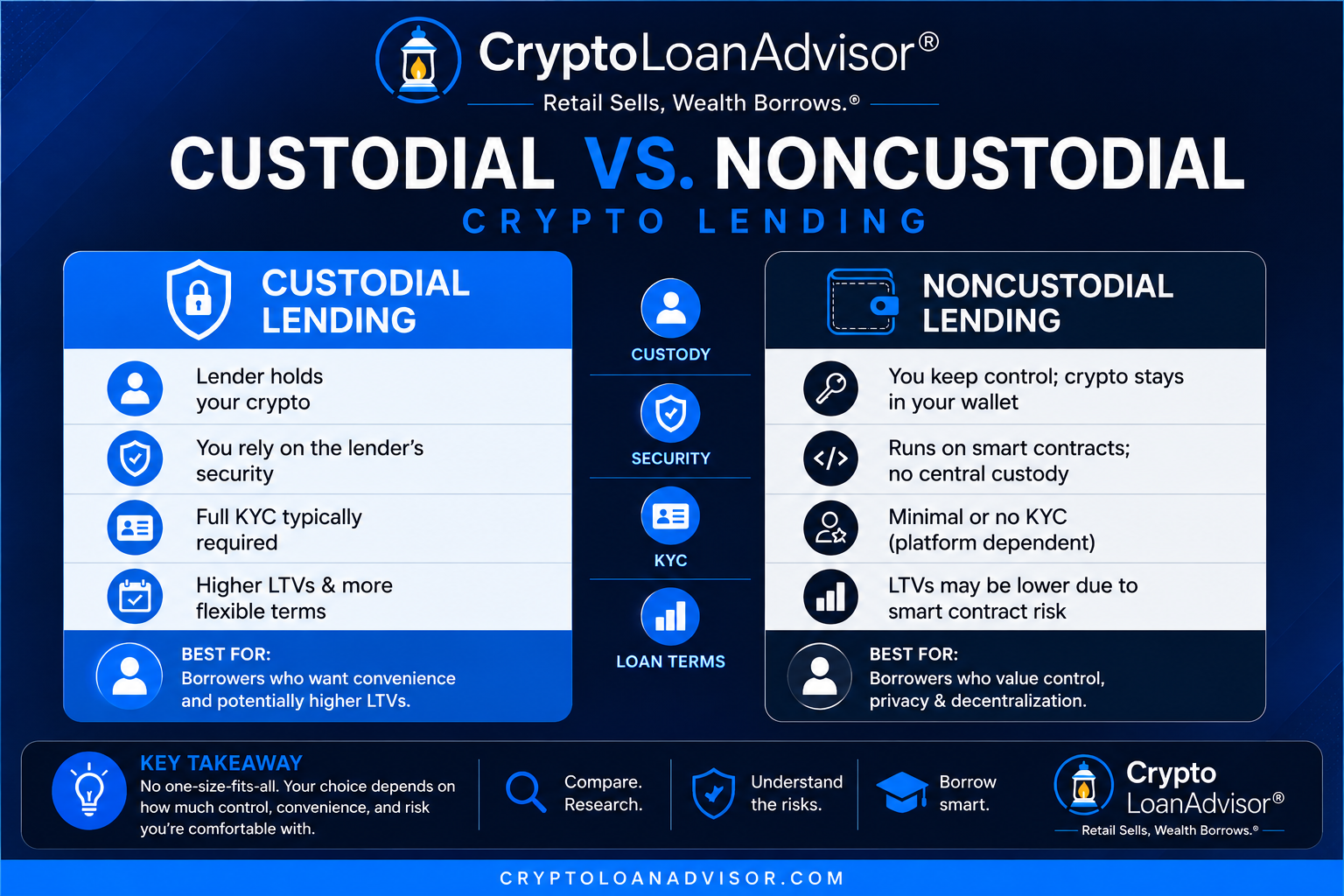
A Bitcoin holder who borrows against $100,000 of BTC may receive the same dollar loan from two providers, yet take on two very different kinds of risk. In custodial versus noncustodial crypto lending, the central question is not simply who offers the lower advertised rate. It is who controls the collateral, how liquidation can occur, and what happens if the lender, platform, or underlying technology fails.
For investors using a Borrow, Don’t Sell strategy, that distinction matters. Borrowing can create liquidity for a business expense, real estate opportunity, tax bill, or portfolio need while preserving exposure to Bitcoin, Ethereum, XRP, Solana, or another digital asset. But retaining upside only helps if the loan structure matches your risk tolerance and operational ability.
What custodial crypto lending means
With a custodial crypto loan, a centralized company generally takes possession or control of your collateral for the life of the loan. You deposit assets into an account or wallet controlled by the lender or its custodian, and the lender extends cash, stablecoins, or another loan proceeds format under its underwriting terms.
The provider typically manages the collateral valuation, loan-to-value ratio, margin-call process, interest billing, and liquidation workflow. This can feel familiar to borrowers accustomed to traditional finance: there is an account dashboard, customer support, stated loan terms, and often a defined process for repayment and collateral release.
The trade-off is direct. You no longer control the private keys to the pledged assets. Your ability to recover that collateral depends on the provider honoring its obligations, maintaining adequate operational controls, and remaining financially sound.
Custodial lending does not automatically mean poor security or poor terms. Some providers use institutional custodians, segregated account structures, insurance arrangements, and human-assisted risk management. Those features may be valuable, especially for borrowers who prefer a guided experience. Still, they do not remove counterparty risk. Read the legal agreement to understand whether your assets are held in custody, rehypothecated, lent onward, commingled, or subject to claims in an insolvency event.
What noncustodial crypto lending means
Noncustodial lending is usually built around self-custody and smart contracts. Rather than transferring assets to a company-controlled account, you connect a wallet and place collateral into a blockchain-based protocol or contract. The contract enforces borrowing limits and can allow you to draw stablecoins or other supported assets against your collateral.
In many designs, you retain control of the wallet that interacts with the protocol. But that does not mean your collateral is freely available. Once deposited, it is governed by the smart contract’s rules until you repay, withdraw, or face liquidation. The protocol may liquidate collateral automatically when its value falls below a required threshold.
This structure reduces reliance on a single centralized lender, but it replaces some counterparty exposure with technology, governance, and execution risk. Smart contract vulnerabilities, oracle failures, chain congestion, wallet-security mistakes, and abrupt changes in protocol parameters can all affect the borrower.
The label also deserves scrutiny. “Noncustodial” is not a universal legal or operational standard. A platform may call itself noncustodial while relying on intermediaries for identity checks, front-end access, price feeds, stablecoin issuance, or liquidation infrastructure. Ask exactly where collateral sits, what permissions the contract has, and what party can alter the system’s rules.
Custodial versus noncustodial crypto lending: the real differences
The most useful comparison is not centralized versus decentralized as an ideology. It is a practical assessment of control, risk, and borrower responsibility.
Control of keys and assets
In a custodial structure, the lender or custodian controls the keys to pledged collateral. You are trusting the provider’s custody practices and legal commitments. In a noncustodial structure, you generally initiate transactions from your own wallet, but collateral deposited into a contract remains subject to programmed conditions.
Self-custody gives you more direct responsibility. A lost seed phrase, malicious wallet approval, or transaction signed through a compromised device can be irreversible. For some investors, that responsibility is a feature. For others, professional custody and support may be worth the additional counterparty exposure.
Loan availability and flexibility
Custodial lenders may offer fiat loan proceeds, fixed-term loans, larger borrowing capacity, and underwriting designed for U.S. borrowers. They may also support collateral assets that are not commonly accepted by on-chain protocols, including XRP or a wider selection of major tokens.
Noncustodial protocols often provide faster access and continuous availability for eligible collateral, commonly with stablecoin borrowing. However, access can be constrained by network, wallet, token, and liquidity requirements. Converting borrowed stablecoins to dollars may introduce separate costs, timing considerations, and compliance steps.
Interest rates and total cost
A low stated rate is only one part of cost. Custodial loans can include origination fees, administrative charges, early repayment rules, withdrawal fees, and spread embedded in collateral conversion. Noncustodial loans may include variable borrow rates, network fees, protocol fees, stablecoin swap costs, and potentially higher costs during periods of intense demand.
Compare the annualized total cost under realistic conditions. Also ask whether the rate is fixed or variable, how frequently it accrues, which currency it is charged in, and what happens if you pay interest late. A loan that looks inexpensive at origination can become materially more expensive if rates reset or if a stablecoin conversion is required at an unfavorable price.
Liquidation mechanics
This is where loan structures become most consequential. Both models use collateral values and loan-to-value, or LTV, ratios to protect the lender or protocol. If your collateral declines, your LTV rises. At a stated threshold, you may receive a margin call, be required to add collateral or repay debt, or have collateral sold.
Custodial platforms may offer alerts, grace periods, or a manual support process. Do not assume they will. Their ability to act quickly can also depend on market conditions, internal policies, and the terms you accepted.
Noncustodial protocols commonly use automated liquidation. When the threshold is reached, third-party liquidators can repay part of your debt and claim a portion of your collateral at a discount. Automation removes delay, but it can be unforgiving during a sharp overnight move. A borrower cannot depend on an email alert arriving before an on-chain liquidation executes.
Choose based on your operating reality
Custodial lending may fit an investor who wants dollar proceeds, a more conventional service experience, and a provider with documented custody, support, and loan administration. It can also be more practical for borrowers who are not comfortable managing wallet permissions, gas fees, or smart-contract interactions.
Noncustodial lending may fit a technically capable holder who values direct wallet control, accepts variable on-chain conditions, and can actively monitor collateral health. It can be particularly attractive when speed and protocol-level transparency matter more than human assistance.
Neither approach is automatically safer. A well-run custodian can have stronger controls than a poorly designed protocol. A mature protocol with transparent, battle-tested contracts may present a different risk profile than a lightly regulated lender with unclear balance-sheet practices. The correct question is: which risks can you evaluate, monitor, and afford to carry?
How to compare a crypto loan before pledging collateral
Before moving a single token, model the loan against a downside scenario. If you borrow $25,000 against $100,000 of ETH at a 25% starting LTV, calculate what happens if ETH falls 30%, 40%, or 50%. Identify the margin-call LTV, liquidation LTV, liquidation penalty, and the exact action required to restore the account.
Then review the lender or protocol from several angles:
- Determine who has custody or contractual control of collateral and whether assets can be rehypothecated.
- Read the liquidation rules, including notice periods, partial versus full liquidation, and penalties.
- Compare all-in borrowing cost, not only the headline interest rate.
- Verify supported assets, loan proceeds options, repayment terms, geographic availability, and identity requirements.
- For on-chain loans, review contract audits, oracle design, governance authority, wallet approvals, and blockchain-specific risks.
Keep your initial LTV conservative. Maximum borrowing capacity is not a recommendation. A lower LTV leaves room for volatility and reduces the chance that a temporary market decline forces the sale you were trying to avoid.
CryptoLoanAdvisor’s investor-first framework is simple: compare structures before comparing promotions. The provider with the best introductory rate is not necessarily the provider with the clearest custody terms or the most manageable liquidation policy.
Borrowing against digital assets can preserve ownership and create useful flexibility, but it turns market volatility into an active obligation. Choose the structure you understand, maintain a repayment plan that does not rely on perfect market timing, and never pledge more collateral than you can responsibly risk.




