
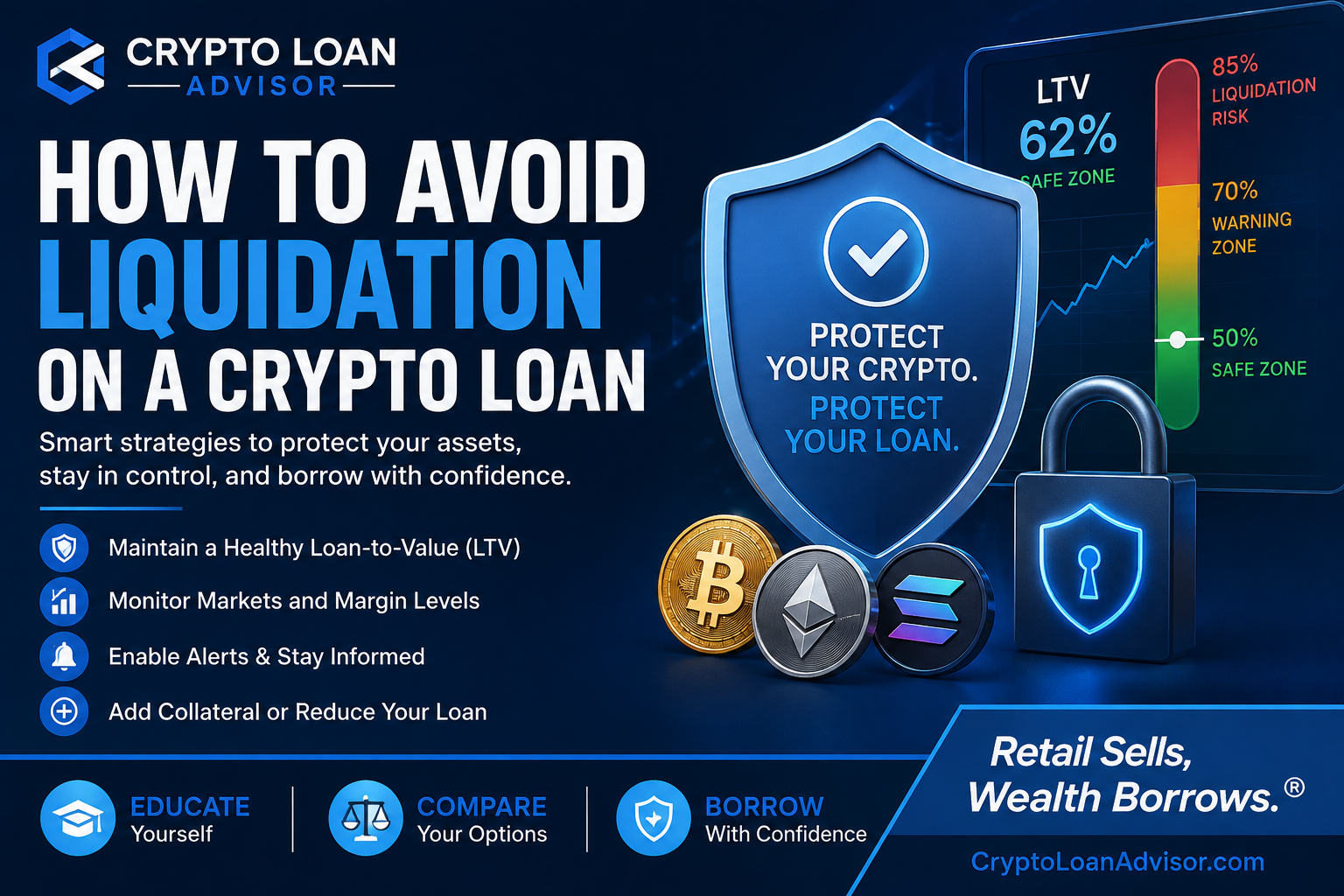
A crypto-backed loan can provide cash without forcing you to sell Bitcoin, Ethereum, XRP, Solana, or another long-term holding. But the strategy only works if you can avoid liquidation when markets turn against your collateral. A loan that feels conservative during a calm market can become dangerous after one sharp weekend decline.
Liquidation is not a theoretical risk or a fine-print detail. It is the point at which a lender can sell some or all of your pledged collateral because the loan has become too large relative to its value. For investors who borrow to preserve upside exposure, that can mean losing the very asset they intended to keep.
The practical goal is not to borrow the maximum amount available. It is to build enough room for volatility, understand the lender’s rules, and act well before a margin call becomes a forced sale.
How to Avoid Liquidation Before You Borrow
The strongest liquidation defense is established before funds ever reach your bank account. Start by treating the lender’s maximum loan-to-value ratio, or LTV, as a ceiling rather than a recommendation.
LTV measures your loan balance against the current value of your pledged crypto. If you deposit $100,000 in BTC and borrow $30,000, your starting LTV is 30%. If Bitcoin falls to $60,000 while the loan balance remains $30,000, your LTV rises to 50%.
That rising LTV is what creates pressure. Lenders typically set an initial LTV, a margin-call LTV, and a liquidation LTV. The exact numbers vary by provider and asset, but the pattern is consistent: as collateral value falls, your risk increases. A lender may ask you to add collateral or repay part of the loan at one threshold, then sell collateral at a higher threshold if you do not respond in time.
Borrow less than the platform says you can
A platform may allow a 50% initial LTV, but starting there leaves limited room for an asset class known for large drawdowns. A 20% to 30% starting LTV is often more resilient for investors using volatile crypto as collateral. It may provide less immediate cash, but it gives the position more capacity to absorb a market decline.
The right starting LTV depends on the asset, your income, your available reserves, and your confidence in your ability to respond quickly. BTC may have different lending terms and historical volatility than smaller-cap tokens. A loan against a concentrated altcoin position usually warrants more caution than one backed by a diversified collateral pool, assuming the lender accepts that structure.
Think of borrowing capacity as optionality, not a spending target. Retail sells under pressure. Wealth borrows with a buffer.
Stress-test the loan against a real drawdown
Do not base your loan decision on a 10% decline. Crypto can move much further, often quickly and outside regular banking hours. Model what happens if collateral falls 25%, 40%, and 60% while your loan balance stays the same.
Suppose you pledge $200,000 in ETH and borrow $50,000. Your initial LTV is 25%. If ETH falls 40%, collateral drops to $120,000 and your LTV rises to 41.7%. That may still be manageable under many loan structures. Start with a $90,000 loan, however, and the same decline pushes LTV to 75% – potentially near or beyond a lender’s liquidation threshold.
This exercise makes the trade-off clear. Higher LTV produces more liquidity today, but it can turn temporary market volatility into a permanent loss of coins tomorrow.
Know the Terms That Control Your Risk
Two lenders can quote similar interest rates while offering very different liquidation risk. The rate matters, but it is only one part of the loan. Read the loan agreement and product disclosures for the rules that determine when and how collateral can be sold.
Focus on the initial LTV, margin-call threshold, liquidation threshold, and required response time. Also determine whether the lender uses a single collateral price source or an index, how frequently it revalues collateral, and whether liquidation is partial or full.
A margin call is a warning, not a solution. Some providers may notify you by email, text, or app alert; others may have limited obligations beyond the terms you accepted. Notifications can be delayed, missed, or buried in a crowded inbox. Your plan should not depend on seeing one message at exactly the right moment.
Ask whether you can make principal repayments at any time, add eligible collateral quickly, or choose to repay with stablecoins, fiat, or crypto. Operational flexibility can matter more than a small difference in annual percentage rate during a fast selloff.
Watch for interest-rate and loan-balance effects
Interest can increase your outstanding balance over time. On some loan structures, unpaid interest is added to the balance, which gradually raises your LTV even if the crypto price does not move. Variable-rate loans can also become more expensive if market conditions change.
If cash flow is tight, plan for interest payments separately rather than assuming collateral appreciation will cover the cost. Borrowing against crypto is most durable when the borrower has a credible repayment source – income, business cash flow, a planned liquidity event, or liquid reserves. It is less durable when repayment depends entirely on the collateral rising.
Build a Margin-Call Response Plan
A lower LTV is the first line of defense. A prepared response plan is the second. Before opening a loan, decide exactly what you will do if your LTV approaches your personal warning level.
Your personal warning level should sit below the lender’s margin-call threshold. If a lender sends a margin call at 60% LTV, you might decide to act at 45% or 50%. The specific number depends on the asset and your resources, but the principle is simple: make decisions while you still have time and choices.
You generally have three ways to reduce LTV: add more eligible collateral, repay part of the principal, or do both. Adding collateral preserves your existing loan cash, but it increases the amount of crypto tied to the lender. Repaying principal reduces debt and risk, but it requires available cash or other liquid assets. Neither option is automatically best.
Keep the resources for that decision outside the pledged collateral. An emergency reserve in cash or stablecoins can be useful, but stablecoins carry their own issuer, custody, and depegging risks. If you plan to use other crypto as backup collateral, confirm in advance that the lender accepts it and understand how its correlation with your original collateral could affect the plan. In a broad crypto selloff, both assets may decline together.
Set price alerts for your collateral and LTV alerts if the lender provides them. Use more than one notification channel where possible. Then check that you can actually access your accounts, complete a repayment, and transfer accepted collateral without delays from banking limits, wallet security procedures, or identity verification.
Avoid Common Liquidation Mistakes
The most damaging mistakes are usually made when the market is calm. Borrowers overestimate how much time they will have, underestimate volatility, or assume a lender will negotiate during a decline.
Avoid these four traps:
- Borrowing at the maximum available LTV because the interest rate looks attractive.
- Using loan proceeds for highly speculative trades that create a second source of market risk.
- Pledging nearly all of your crypto, leaving no unencumbered assets or liquidity to manage a margin call.
- Ignoring lender concentration risk by placing a major share of your portfolio with one provider without evaluating custody, financial condition, security practices, and contractual rights.
The second point deserves special attention. Borrowing against Bitcoin to buy more volatile crypto, fund leveraged trading, or chase a short-term trade can compound risk. You are no longer using debt simply for liquidity. You are using a volatile asset as collateral to support another uncertain bet.
A crypto-backed loan may make more sense for a planned expense, a business need with defined cash flow, or tax-aware liquidity planning reviewed with qualified professionals. It is generally a weaker fit for expenses you cannot service or investments that require perfect market timing.
Compare Lenders for More Than the Lowest Rate
Before transferring collateral, compare providers on the terms that govern your downside. Look at supported assets, initial and maximum LTVs, margin-call and liquidation policies, repayment options, interest structure, custody arrangements, availability by state, and the lender’s operational history.
Pay close attention to whether assets are held in segregated custody, how the provider describes its rights over collateral, and whether it can rehypothecate or otherwise use pledged assets. These terms affect more than convenience. They shape counterparty risk if the lender experiences financial stress.
CryptoLoanAdvisor’s education-first approach is useful here: compare the structure behind the advertised rate, not just the rate itself. The best product is not necessarily the one offering the largest loan. It is the one whose LTV, collateral rules, costs, and risk controls fit your financial position.
Keep Control of the Decision
No LTV can guarantee that you will avoid liquidation. Extreme price moves, platform disruptions, interest accrual, and personal cash-flow constraints can all change the outcome. But disciplined borrowing can materially improve your odds.
Use crypto-backed debt to create flexibility, not fragility. Borrow an amount you can defend through volatility, keep a clear plan for reducing LTV, and choose a lender only after you understand the rules that apply when markets are least forgiving. Preserving ownership starts with refusing to put your ownership at unnecessary risk.




