
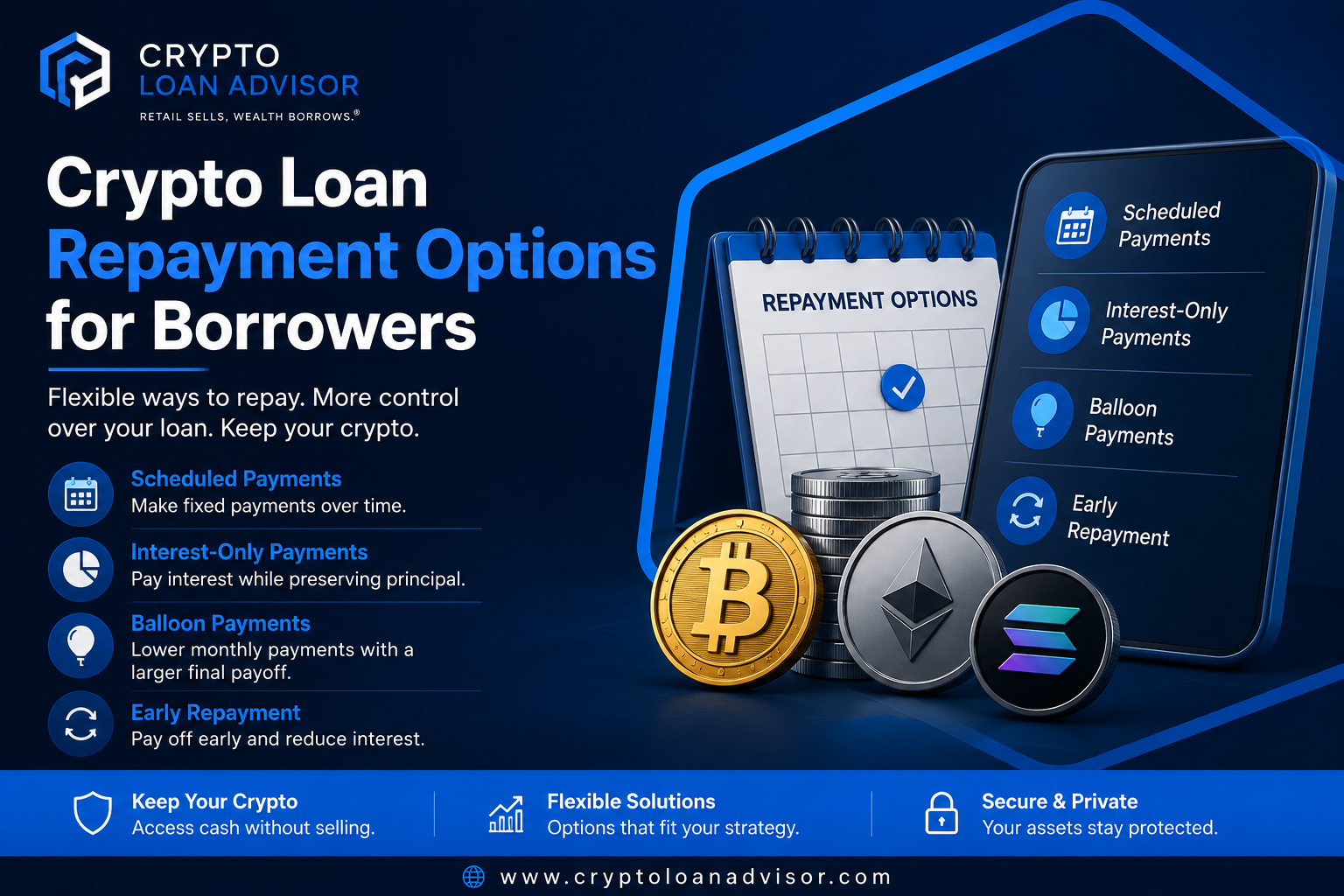
A crypto-backed loan can preserve your exposure to Bitcoin, Ethereum, XRP, Solana, or another asset while giving you cash for a business need, tax bill, home project, or market opportunity. But crypto loan repayment options determine whether that liquidity remains useful or becomes a source of portfolio pressure. Before posting collateral, understand exactly when principal is due, how interest accrues, what currency you can use to pay, and what happens if your collateral falls sharply.
Retail sells. Wealth borrows only when the loan structure supports the plan. Repayment terms are not a minor detail after funding. They are part of the risk management decision from day one.
The Main Crypto Loan Repayment Options
Most crypto-backed loans fall into one of three repayment structures: interest-only payments with principal due later, amortizing payments that reduce principal over time, or a single payment at maturity. Some lenders also permit flexible or early repayment without a prepayment penalty. The exact combination depends on the lender, loan type, collateral asset, and the state where you live.
Interest-only payments with a balloon payoff
Interest-only is common in crypto lending. You pay accrued interest monthly or at another stated interval, while the original loan balance remains unchanged. At the end of the term, you repay the principal in one lump sum, often called a balloon payment.
This structure keeps required periodic payments low. A borrower who takes a $100,000 loan at a 12% annual rate, for example, may owe roughly $1,000 in monthly interest while the $100,000 principal remains due at maturity. That can suit a holder expecting future income, a planned liquidity event, or a long-term investment horizon.
The trade-off is obvious but significant: the principal does not shrink. If you do not have a realistic plan to repay, refinance, or reduce the balance before maturity, interest-only payments can merely postpone the hard decision. Refinancing should be viewed as a possibility, not a repayment strategy you can assume will be available. Rates, lender policies, collateral values, and market conditions can all change.
Amortizing loan payments
An amortizing loan requires recurring payments of principal and interest. Each payment gradually reduces the amount owed. This is familiar to borrowers with auto loans, mortgages, or traditional personal loans.
For crypto borrowers, amortization can provide a disciplined path to a lower loan-to-value ratio, or LTV. As principal declines, the loan becomes less dependent on a rising collateral price to stay healthy. That matters during volatile markets, when reducing the debt balance can be as protective as adding collateral.
The cost is a higher monthly cash requirement. An entrepreneur using borrowed funds to support uneven business cash flow may prefer interest-only flexibility. A salaried investor with predictable income may find an amortizing structure more comfortable because it steadily removes debt risk.
Full repayment at maturity
Some short-term loans allow interest and principal to be paid when the loan matures. This may work for a defined, near-term need, such as bridging a purchase or covering an expense before an expected cash payment arrives.
It is generally the least forgiving structure for borrowers without a clear repayment source. Interest can accumulate, the balance may be larger than anticipated, and collateral volatility continues throughout the term. A maturity date is not a suggestion. Missing it may trigger default provisions, higher rates, collateral liquidation, or other remedies described in the loan agreement.
How Can You Repay a Crypto-Backed Loan?
Repayment currency is a practical detail that deserves the same attention as the advertised interest rate. Depending on the provider and product, you may be able to repay using U.S. dollars, a bank transfer, stablecoins, cryptocurrency, or a combination of these. Do not assume that a lender accepts the same token you deposited as collateral.
Dollar or bank-transfer repayment offers the cleanest budgeting experience for many U.S. borrowers. Your debt is usually denominated in dollars, so paying dollars avoids adding a second asset-price variable to the repayment process.
Stablecoin repayment can be convenient for investors whose working capital already sits on-chain. Yet stablecoins carry their own considerations, including transfer fees, wallet accuracy, platform support, and potential depegging risk. Confirm accepted networks before sending funds. A payment sent on an unsupported network may not be recoverable.
Crypto repayment may appeal to borrowers with diversified holdings, but it requires extra care. If you use appreciated crypto to make a payment, the transaction may create a taxable disposition under current U.S. tax treatment. Paying a loan with crypto is not automatically tax-neutral simply because the original loan proceeds were not income. Consult a qualified tax professional for advice based on your facts.
A few providers may offer a collateral-sale mechanism that uses some of your pledged assets to reduce or close the loan. Treat this as an exit tool, not as a benefit that eliminates risk. Selling collateral can reduce your upside exposure, may have tax consequences, and could occur when prices are depressed.
Early Payoff, Partial Payments, and Prepayment Terms
A strong repayment plan includes the ability to improve it. Before borrowing, ask whether you can make a partial principal payment, repay the loan early, and withdraw excess collateral after reducing the balance.
Early payoff can save interest, especially on loans where interest stops accruing as soon as the lender receives the payoff. But the details matter. Some products have minimum interest periods, origination fees that are not refundable, or prepayment penalties. Others calculate interest daily, making early repayment more economically attractive.
Partial principal payments are especially valuable during a market rally or after a business generates surplus cash. Reducing a $100,000 balance to $75,000 lowers your LTV immediately, assuming collateral is unchanged. That can create more room before a margin call or liquidation threshold is reached.
Ask how a lender applies each payment. Does it cover outstanding fees first, then interest, then principal? Does a partial payment automatically lower your monthly obligation, shorten the term, or simply reduce the balloon amount due later? These operational rules affect the real value of flexibility.
Repayment Does Not Replace Collateral Management
A borrower can make every scheduled payment and still face liquidation if collateral value falls far enough. That is the central difference between managing a standard installment loan and managing a crypto-backed loan.
Your LTV compares the loan balance with the market value of your collateral. If you borrow $25,000 against $100,000 of Bitcoin, the opening LTV is 25%. If Bitcoin falls and the collateral value drops to $50,000, the LTV rises to 50% even though you have not missed a payment.
Lenders set margin-call and liquidation thresholds differently. A margin call may require you to add collateral or repay some principal. A liquidation threshold allows the lender to sell pledged collateral, often quickly, to bring the loan back within its required range. Review whether notifications are discretionary, how much time you have to respond, and whether the lender can liquidate without further approval.
This is why a lower starting LTV can be more valuable than a slightly lower interest rate. Borrowing less gives your assets room to move. For long-term holders, preserving ownership through a drawdown may matter more than maximizing the cash received on day one.
Build a Repayment Plan Before You Borrow
The most effective plan names a repayment source that does not depend entirely on your collateral rising. That source could be salary, business revenue, cash reserves, a known bonus, a maturing investment, or funds earmarked for the purpose of the loan.
Keep enough liquidity outside the pledged collateral to make payments and respond to market stress. If your plan is to sell other crypto during a downturn to protect the loan, consider whether that truly gives you flexibility or simply spreads the same market risk across more of your portfolio.
Before selecting a provider, compare the annual percentage rate or stated interest rate, payment schedule, term length, accepted repayment methods, early-payoff policy, minimum payment rules, starting LTV, margin-call threshold, liquidation threshold, custody arrangement, and default provisions. CryptoLoanAdvisor’s educational approach begins with this comparison because a loan is only as useful as its terms under pressure.
Borrowing against digital assets can help you keep long-term holdings intact, but only when the repayment obligation fits your cash flow and your downside plan. Choose the structure you could manage during a weak market, not just the one that looks attractive when prices are climbing.




