
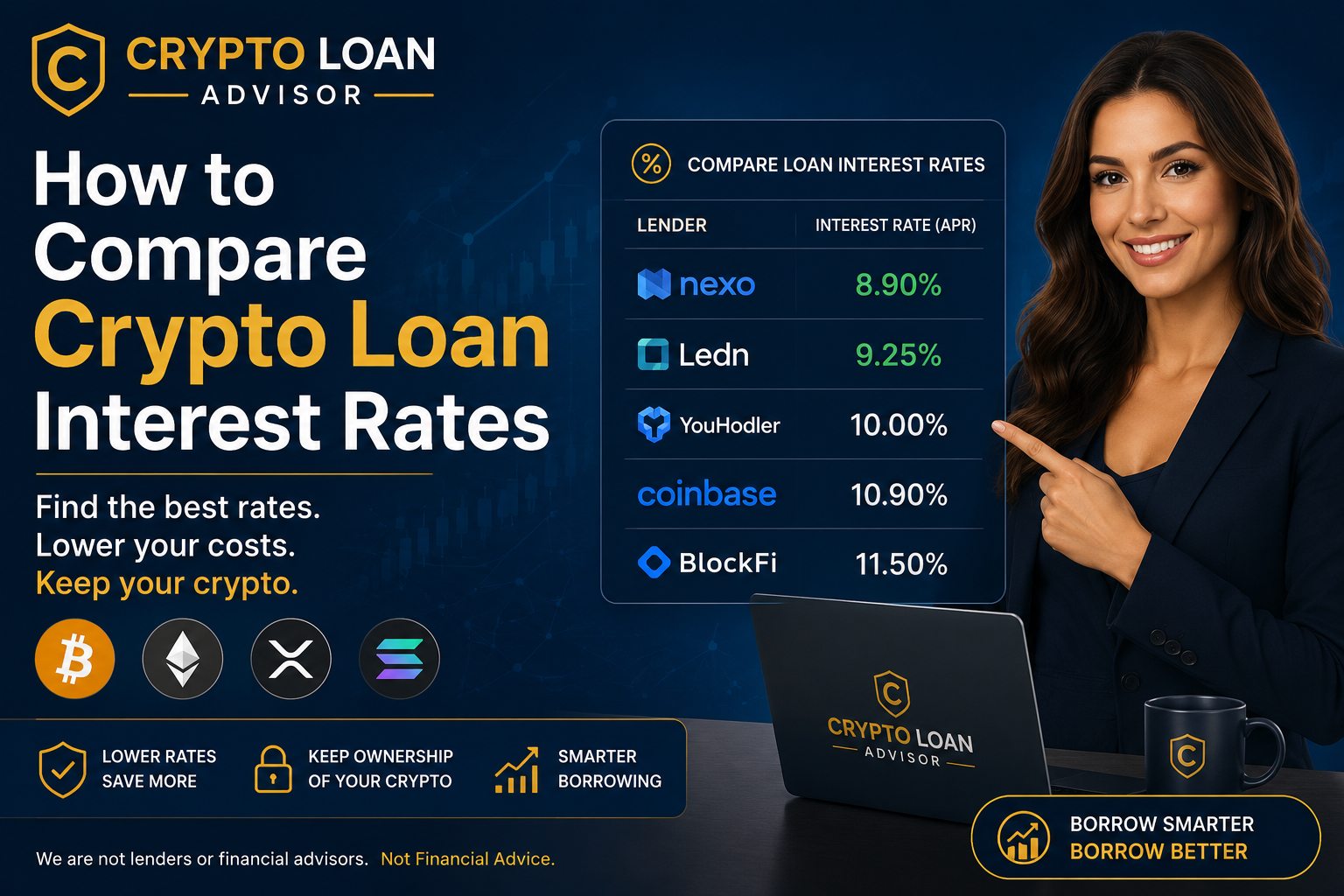
A quoted rate can look inexpensive until you see the loan-to-value ratio, origination fee, collateral requirements, and liquidation trigger behind it. To compare crypto loan interest rates intelligently, treat the APR as one part of the borrowing decision, not the decision itself. The goal is not simply to find the lowest number. It is to obtain liquidity while keeping your ownership, downside risk, and total borrowing cost aligned.
For long-term Bitcoin, XRP, Ethereum, or Solana holders, that distinction matters. Selling assets for cash can end upside exposure and potentially create a taxable event. Borrowing against them can preserve optionality, but only if the loan structure can withstand the volatility that comes with digital assets.
Compare Crypto Loan Interest Rates Beyond the Headline APR
Crypto-backed loan pricing is commonly advertised as an annual percentage rate, or APR. In plain terms, APR represents the yearly interest charged on the amount you borrow. A 10% APR on a $20,000 loan costs roughly $2,000 in annual interest before considering fees, compounding, or changes in the loan balance.
That calculation is useful, but it is not enough. One lender may advertise a 7% rate at a conservative 25% loan-to-value ratio, while another offers 10% at 50% LTV. The first requires twice as much collateral for the same cash. The second gives you more liquidity, but leaves less room for a market decline before your position becomes stressed.
Rate tiers can also change the comparison. Some providers price loans based on collateral type, loan size, term length, LTV, or whether interest is paid monthly or added to the balance. Bitcoin-backed loans may receive different terms than loans secured by smaller or more volatile altcoins. A promotional rate may apply only to a narrow borrower profile or a limited period.
Read the rate as a condition of the full loan package. Ask what must be true for you to receive it, how long it remains in force, and whether the lender can change it during the loan term.
APR versus interest cost
A lower APR generally reduces the cost of holding debt, especially for a loan intended to remain open for months or years. But compare the actual dollar cost for your expected time horizon. If you expect to repay in 90 days, an upfront fee can matter more than a modest difference in annual rate.
For example, a $25,000 loan at 9% APR carries about $1,875 in simple annual interest. Over three months, that is roughly $563. A competing loan at 7% APR would cost about $438 over the same period, a savings of about $125. If the lower-rate loan charges a $300 origination fee, it is more expensive for the short-term borrower.
This is why the best rate is often time-dependent. Short-term liquidity needs reward low fees and flexible repayment. Longer borrowing horizons make rate discipline increasingly valuable.
The Numbers That Change What a Rate Is Worth
The core math of a crypto-backed loan is collateral value divided by loan balance. Loan-to-value ratio, or LTV, shows how much you borrow relative to the value of assets pledged. Deposit $100,000 of Bitcoin and borrow $25,000, and your starting LTV is 25%.
A lower starting LTV usually means a wider safety margin. It may also qualify you for a better rate. The trade-off is capital efficiency: more of your portfolio must sit as collateral to access the same amount of cash.
A higher LTV improves immediate liquidity but reduces your margin for error. If crypto prices decline, your LTV rises because the collateral is worth less while the debt remains. At a certain point, the lender may issue a margin call, require additional collateral, sell some collateral, or liquidate the position under its agreement.
Liquidation threshold matters more than a small rate gap
Suppose two loans are available. Loan A charges 8% APR at 25% starting LTV and has a 70% liquidation threshold. Loan B charges 6.5% APR at 50% LTV with an 80% liquidation threshold. Loan B looks cheaper, but it begins much closer to its danger zone.
If the collateral drops 40%, Loan A’s LTV rises from 25% to about 42%. Loan B’s rises from 50% to about 83%, potentially beyond its liquidation point. The borrower who chose Loan B saved interest but may have accepted a much greater risk of losing assets during a sharp drawdown.
There is no universal “safe” LTV. Bitcoin’s market behavior differs from Solana’s, XRP’s, or Ethereum’s, and every holder has a different capacity to add collateral or repay quickly. Still, conservative LTV is one of the clearest ways to protect a Borrow, Don’t Sell strategy from turning into forced selling at the wrong time.
Calculate the True Cost of Crypto Liquidity
Before selecting a lender, estimate total borrowing cost using the exact loan amount, expected repayment date, and all stated charges. Interest is only one component. Review origination fees, closing fees, withdrawal fees, late-payment charges, collateral transfer costs, prepayment penalties, and any spread built into asset conversion or liquidation procedures.
Also confirm how interest accrues. Is it simple interest, compounding interest, or interest that is added to the principal? Is payment due monthly, at maturity, or in crypto? A loan that permits interest to accrue against the balance can preserve cash flow, but it also slowly raises LTV if the collateral price stays flat.
Variable-rate loans deserve additional attention. A rate that starts attractively may increase with market conditions or according to a lender’s internal pricing policy. Fixed rates provide more predictable carrying costs, though they may begin higher. The right choice depends on whether you value payment certainty or believe you can repay before rate changes become material.
Compare Lender Terms, Not Just Loan Terms
The lender’s operating model is part of the risk analysis. Crypto-backed borrowing requires you to understand who holds collateral, how it is secured, what happens if a platform experiences operational stress, and what rights you have under the loan agreement.
Ask practical questions. Is collateral held by a qualified custodian or controlled directly by the lending platform? Are assets segregated from corporate funds? Does the provider disclose insurance arrangements and their limitations? What is the margin-call process, and how much notice is realistically provided during fast-moving markets?
A lender’s published liquidation threshold is not enough on its own. Review the trigger, the communication process, the time available to cure a shortfall, and whether partial liquidation is possible. Volatile markets can move faster than email notices, particularly outside normal banking hours.
U.S. borrowers should also confirm availability in their state, identity verification requirements, tax reporting practices, and whether the product is structured as a loan rather than a sale or other transaction. Terms can vary by jurisdiction and borrower profile.
A Practical Comparison Framework
When evaluating offers, put each candidate loan into the same framework: the APR, all upfront and ongoing fees, starting LTV, margin-call level, liquidation threshold, rate type, repayment flexibility, collateral custody model, and required collateral asset. Comparing these side by side prevents a low advertised rate from obscuring a restrictive or risky structure.
Then pressure-test the loan against your own portfolio. What happens if your collateral falls 30%, 50%, or more? Could you post additional Bitcoin or other approved assets? Would you have cash available to reduce principal? Are you borrowing for a productive use, such as business working capital, a tax obligation, or a planned purchase, or simply extending spending beyond your capacity?
Borrowing against crypto works best when the debt serves a clear purpose and repayment is plausible without relying entirely on a future price increase. Appreciation can strengthen a collateral position, but it should not be the only repayment plan.
CryptoLoanAdvisor’s role in a comparison process is educational: evaluate the structure, read the terms, and make the trade-offs visible before assets move. A disciplined borrower does not chase the lowest advertised APR. They choose a loan whose cost, collateral buffer, and lender terms still make sense when the market is less forgiving.
Your crypto holdings can provide liquidity without requiring an immediate sale. Protect that advantage by pricing the loan in full, keeping room for volatility, and borrowing only at a level you can manage with confidence.




