
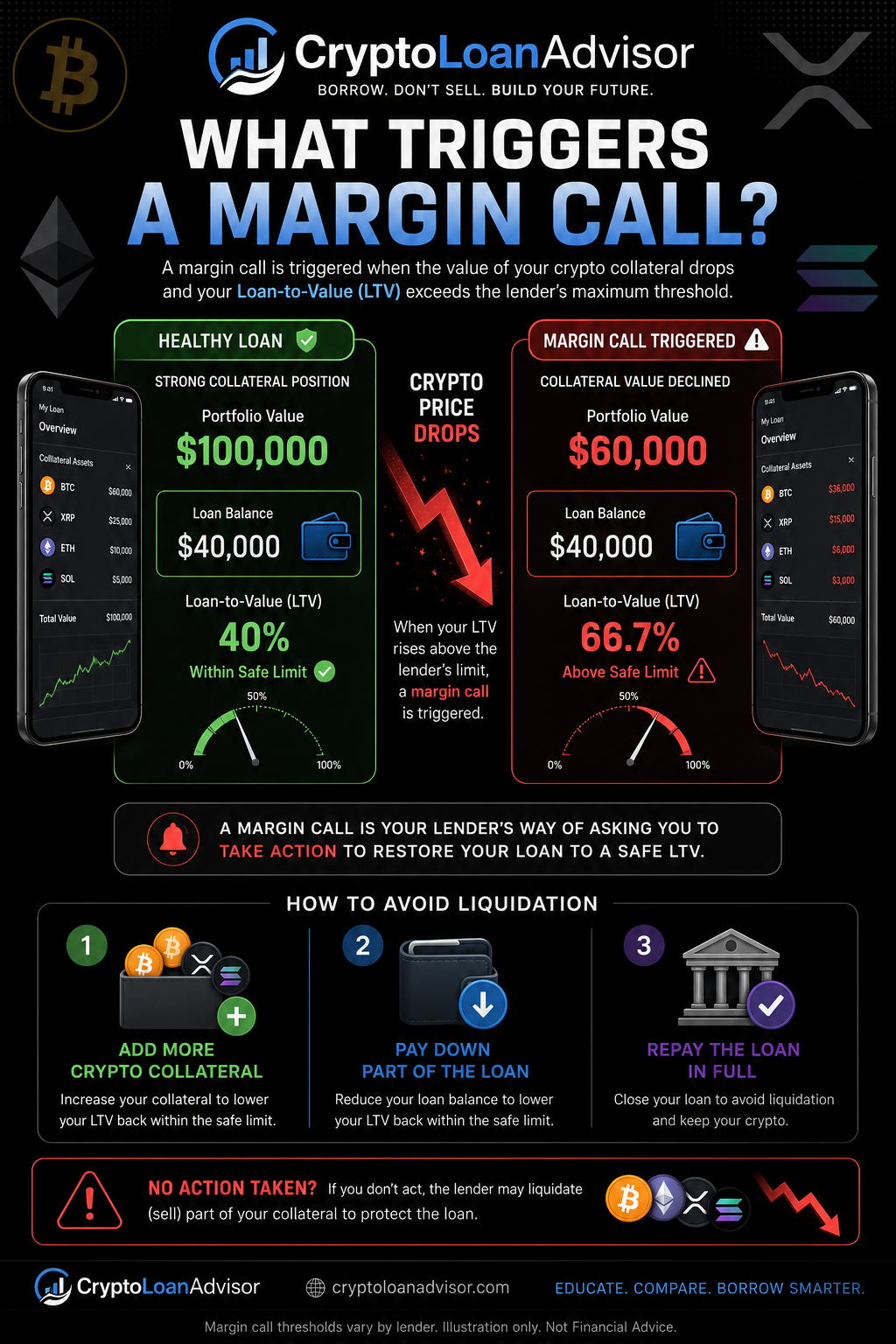
A crypto-backed loan can turn a long-term holding into usable liquidity without forcing a sale. But that flexibility comes with a condition: your collateral must continue to support the loan. Understanding what triggers a crypto margin call is central to borrowing with confidence, especially when Bitcoin, Ethereum, XRP, or Solana moves sharply in a matter of hours.
A margin call is not necessarily a failure or a liquidation. It is a risk warning from the lender that your loan-to-value ratio has reached a specified level and action may be required. The difference matters. Borrowers who understand the mechanics before taking a loan have more choices when markets get volatile.
What triggers a crypto margin call?
A crypto margin call is usually triggered when the value of your pledged collateral falls enough that your loan-to-value ratio, or LTV, rises above the lender’s margin-call threshold. LTV measures the size of your loan relative to the current value of the crypto securing it.
The basic calculation is straightforward:
LTV = outstanding loan balance ÷ current collateral value
Suppose you borrow $25,000 against $100,000 worth of Bitcoin. Your starting LTV is 25%. If Bitcoin declines and the collateral is later worth $62,500, the same $25,000 balance now represents a 40% LTV. If your lender sets its margin-call threshold at 40%, that price decline can trigger a notice.
The loan balance may also increase over time as interest accrues. That means collateral does not have to fall dramatically for LTV to rise. A borrower who takes a loan near the maximum permitted LTV has less room for both market losses and accumulated interest.
Margin-call LTV and liquidation LTV are different
Most crypto lenders set at least two risk thresholds. The first is the margin-call LTV, where the lender asks you to add collateral, make a payment, or otherwise restore the loan to a safer ratio. The second is the liquidation LTV, where the lender may sell some or all collateral under the loan agreement.
For example, a lender could originate a loan at 30% LTV, issue a margin call at 50%, and liquidate at 65%. Those figures are only an illustration. Thresholds differ materially by lender, collateral asset, loan product, and market conditions.
Do not assume a margin call guarantees a generous response window. Some providers offer a stated cure period, while others may reserve broad discretion during fast-moving markets. Read the agreement for the exact thresholds, notification method, timing, and liquidation rights before transferring crypto to any provider.
The main forces that push LTV higher
A falling collateral price is the most obvious trigger, but it is not the only factor. The practical risk comes from how several variables interact.
A decline in the collateral asset
If the asset you posted declines, the value protecting the lender declines with it. This is especially relevant for concentrated positions. A Bitcoin-backed loan may behave differently from a loan secured by a more volatile altcoin, even when both begin at the same LTV.
Volatility is not just a chart concern. It determines how much time a borrower has to act. A gradual 20% decline may leave room to post additional collateral. A weekend gap or sudden liquidation cascade may move an account through a margin-call level quickly.
Interest and fees added to the balance
Depending on the loan structure, unpaid interest, origination fees, or other charges can increase the outstanding balance. As the numerator in the LTV calculation rises, your LTV rises too.
This tends to matter more on longer-duration loans and during periods when the collateral price is flat or modestly down. Ask whether interest is paid monthly in cash, deducted from loan proceeds, paid in crypto, or added to the balance. Each approach affects the buffer differently.
Borrowing too close to the maximum
The maximum available LTV is not necessarily the appropriate LTV. A loan originated at 50% LTV may be permitted, yet it leaves much less downside protection than a loan originated at 20% or 30% LTV.
Lower initial LTV means borrowing less against the same holdings, which can feel conservative when markets are rising. In return, it provides more distance between normal volatility and a forced decision. That trade-off is often the price of preserving ownership through a downturn.
A lender’s valuation and policy terms
Lenders generally value collateral using their own approved pricing sources and calculation schedules. The price displayed on your preferred exchange may not exactly match the price used in your loan dashboard. Some providers monitor LTV continuously, while others calculate at set intervals.
The lender can also have asset-specific rules. Stablecoins, Bitcoin, Ethereum, and smaller-cap tokens may receive different advance rates, thresholds, or eligibility treatment. A lender may change supported assets or collateral requirements under circumstances outlined in its agreement. Independent comparison should focus on these terms, not only the advertised interest rate.
What happens after a margin call?
The exact process depends on the provider, but the lender typically notifies you by email, app alert, phone, or another agreed communication channel. The notice may tell you your current LTV, the required action, the deadline, and the consequences of missing it.
You generally have three ways to improve the ratio. You can add eligible collateral, repay part of the principal, or use a combination of both. Adding collateral preserves the original cash proceeds but increases the amount of crypto committed to the lender. Repaying debt reduces interest expense and lowers risk, but requires available cash or assets.
Some platforms may support automatic collateral transfers or partial liquidation settings. Those features can be useful, but they are not substitutes for understanding the terms. Automation can reduce response time while also selling assets at a price you may not have chosen.
If you do not cure the margin call before the applicable deadline, the lender may liquidate collateral. Liquidation can create a permanent loss of the asset, eliminate future upside on the sold amount, and potentially create tax consequences. If sale proceeds do not cover all obligations, the agreement may also address whether you remain responsible for a shortfall.
Build a margin-call buffer before you borrow
The most effective margin-call strategy begins at origination, not after the alert arrives. Think of initial LTV as your safety margin, not simply your borrowing capacity.
A useful approach is to stress-test the loan against price declines before committing collateral. If you borrow at 25% LTV, estimate what happens if collateral falls 25%, 40%, and 50%, while factoring in expected interest. Then compare those outcomes with the lender’s margin-call and liquidation thresholds.
Keep a realistic response plan as well. Decide in advance whether you would add collateral, repay debt from cash reserves, sell another asset, or accept partial liquidation. The right answer depends on your liquidity, conviction, tax situation, and overall portfolio concentration. It should not be decided in the middle of a sharp sell-off.
It also helps to avoid pledging every available coin. Retaining unencumbered crypto can give you flexibility to respond, but it increases the amount of capital exposed to the same asset. Holding cash or short-duration reserves may be less exciting in a bull market, yet it can be valuable when preserving a core position is the priority.
Questions to ask before choosing a lender
A lower rate does not automatically mean a safer loan. Before comparing providers, get clear answers on the initial LTV, margin-call LTV, liquidation LTV, interest treatment, accepted collateral, monitoring frequency, and notice procedures. Ask whether partial liquidations are used and whether the platform allows you to make early principal payments without penalty.
Also examine custody and counterparty considerations. When crypto is pledged as collateral, the borrower is evaluating more than loan economics. Provider security practices, asset custody arrangements, legal terms, operational history, and customer support can all matter when the market moves quickly.
CryptoLoanAdvisor’s investor-first perspective is simple: borrowing can preserve optionality, but only when the loan structure fits the volatility of the assets securing it. Retail sells under pressure. Wealth plans for pressure before it arrives.
A margin call is best viewed as a prewritten decision point. Choose an LTV that lets you withstand the downside you believe is plausible, keep your response capital accessible, and treat every threshold in the loan agreement as a number that may matter sooner than expected.




