
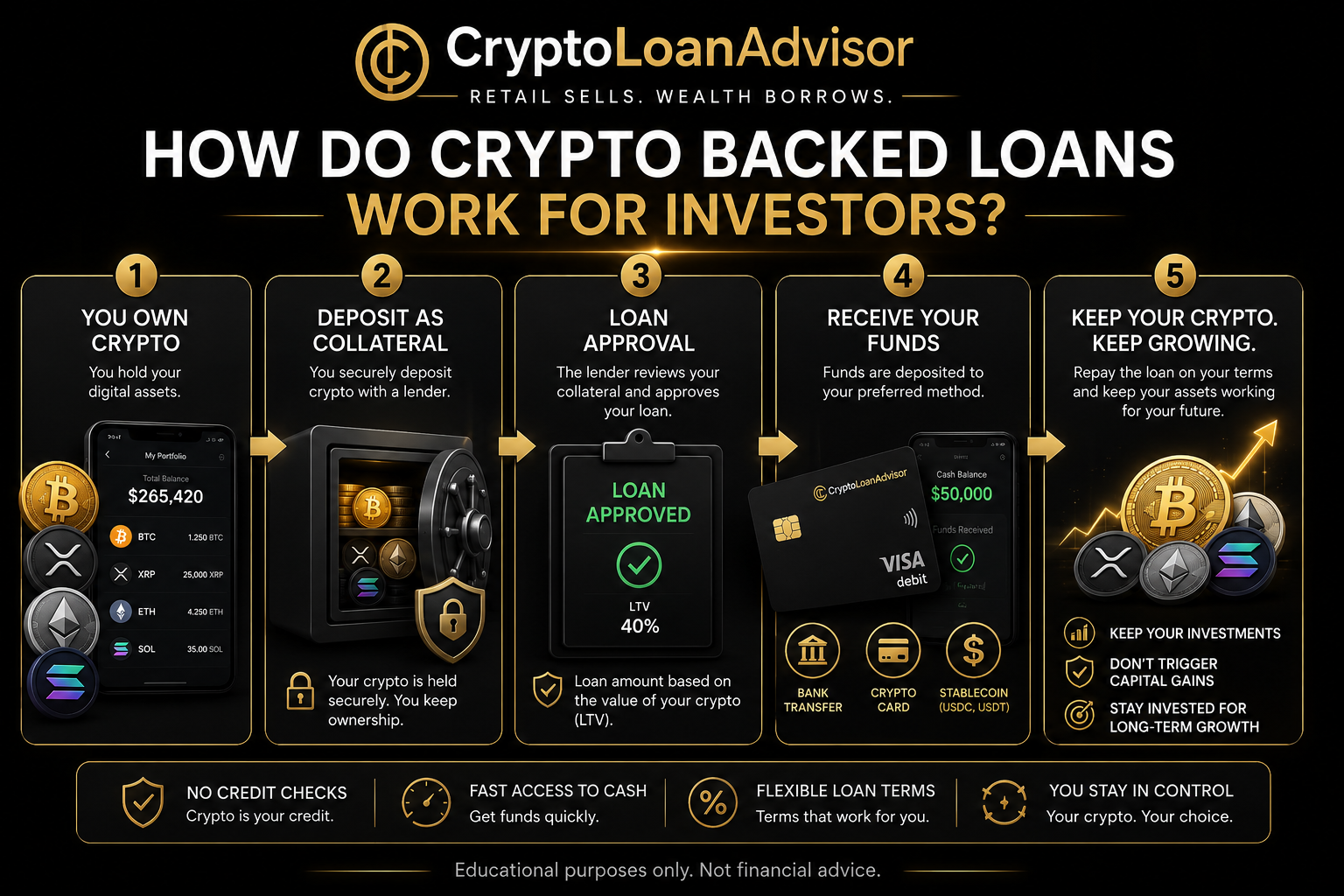
A long-term Bitcoin holder needs $40,000 for a business opportunity. Selling BTC would provide the cash, but it would also reduce exposure to a position they expect to appreciate and could create a taxable event. This is the question behind crypto-backed borrowing: how do crypto backed loans work when you want liquidity but do not want to exit your holdings?
At their best, these loans can turn digital assets into working capital. At their worst, they can force the sale of those same assets during a market decline. The difference comes down to loan structure, collateral management, and whether the borrower has enough room for volatility.
How Do Crypto Backed Loans Work?
A crypto-backed loan lets you pledge eligible digital assets as collateral in exchange for cash, stablecoins, or sometimes another digital asset. Rather than evaluating your W-2 income, credit score, or debt-to-income ratio in the traditional way, the lender focuses primarily on the value and liquidity of the crypto you deposit.
The basic flow is straightforward. You transfer assets such as Bitcoin, Ethereum, XRP, or Solana to the lender or its qualified custody arrangement. The provider assigns a collateral value and offers a loan based on a percentage of that value. After approval, you receive the loan proceeds and make interest payments according to the agreement. When you repay principal and interest, your collateral is released, assuming no liquidation occurred along the way.
This is the digital-asset version of borrowing against a brokerage portfolio, real estate, or another valuable asset. You retain economic exposure to the collateral while the loan is outstanding, but you generally give up direct control of it. That distinction matters. Your coins may still rise in value, yet they are no longer freely available to trade, move, stake, or use elsewhere.
Loan-to-Value Determines Your Risk Buffer
The number to understand before borrowing is loan-to-value, or LTV. It compares what you borrow with the current value of your collateral.
If you pledge $100,000 in Bitcoin and borrow $25,000, your starting LTV is 25%. If the Bitcoin value falls to $50,000, that same $25,000 loan becomes a 50% LTV loan. Nothing about your principal balance changed. The market moved, shrinking your collateral cushion.
A lower starting LTV generally means a wider margin for volatility. A borrower using a 20% to 30% LTV has more protection against a sharp market drawdown than someone borrowing at 50% or 60% LTV. The trade-off is simple: lower LTV produces less immediate liquidity.
Maximum LTV is not necessarily the right LTV. It is simply the highest ratio a provider may allow under certain conditions. For long-term holders who view a forced sale as the outcome to avoid, conservative borrowing is usually more valuable than squeezing the largest possible loan from a portfolio.
A Practical Example
Assume you deposit $200,000 in Ethereum and borrow $60,000. Your opening LTV is 30%. If ETH drops 40%, your collateral is worth $120,000 and your LTV rises to 50%.
Whether that creates a problem depends on the lender’s margin-call and liquidation thresholds. A platform that sends a warning at 55% and liquidates at 70% leaves you some room. A different provider may require action sooner. The published interest rate matters, but these risk thresholds can matter more in a volatile market.
Margin Calls and Liquidation Are the Central Risks
Crypto markets trade around the clock. Collateral can lose significant value overnight, over a weekend, or during a period when you are unable to add funds quickly. That is why crypto-backed loans demand active attention.
A margin call occurs when your LTV reaches a defined level and the lender asks you to restore the required collateral cushion. You may be able to add more crypto, make a partial loan repayment, or do both. Some platforms provide alerts before the formal threshold, but notifications are not a substitute for monitoring your own position.
If the LTV keeps rising and reaches the liquidation threshold, the lender can sell some or all of your collateral to repay the outstanding loan. Liquidation rules vary. One lender may sell only enough collateral to bring the loan back within limits; another may have broader rights under its agreement. Fees, execution price, and timing can all affect the result.
This is the hard truth behind “Borrow, Don’t Sell.” Borrowing can preserve upside only if you manage downside. A loan obtained to avoid selling at a convenient time can result in a sale at an inconvenient time if the collateral falls and the account has insufficient buffer.
What Does a Crypto-Backed Loan Cost?
Interest is the most visible cost. Rates can be fixed or variable, and they often depend on your LTV, loan term, collateral type, payment frequency, and whether you accept loan proceeds in dollars or stablecoins. A lower LTV may qualify for a better rate because it presents less risk to the lender.
Look beyond the headline APR. The real cost can include origination fees, administrative fees, late-payment charges, withdrawal or settlement fees, and liquidation fees. Ask whether interest is paid monthly, deducted from the loan at funding, or accrued until maturity. A loan with interest deducted upfront gives you less usable cash than its stated principal suggests.
Also consider the opportunity cost of pledged assets. If your ETH is locked as collateral, you may miss a staking yield opportunity. If you deposit tokens with a lender rather than holding them in self-custody, you take on counterparty and custody risk. Those costs may not appear in an APR calculation, but they belong in the decision.
Custody and Counterparty Risk Matter as Much as Rate
With a typical crypto-backed loan, the lender or a custody partner controls the collateral while the loan remains open. That makes provider selection a core part of risk management, not a final checkout step.
Read how assets are held, whether collateral is segregated or commingled, what insurance applies and what it does not cover, and what happens in insolvency or bankruptcy. Review the legal entity offering the loan and the borrower agreement governing your assets. Marketing claims about security are not the same as clear contractual protections.
U.S. borrowers should also confirm availability in their state, the form of loan proceeds, applicable disclosures, and tax treatment with a qualified professional. Borrowing itself is generally different from selling for tax purposes, but a liquidation can have tax consequences. The facts matter, particularly when collateral has appreciated substantially since purchase.
When Borrowing May Make Sense – and When It May Not
A crypto-backed loan may fit an investor with a concentrated but high-conviction position, a defined use for the funds, sufficient cash flow to cover interest, and additional reserves to handle a drawdown. Common uses include business capital, a major purchase, bridge financing, or replacing a short-term cash need without immediately selling long-term holdings.
It may be a poor fit if you need every dollar of the loan to cover recurring expenses, have no additional liquidity, or would be financially harmed by a rapid collateral sale. Borrowing to increase crypto exposure can be especially dangerous: it adds leverage to an already volatile asset base.
Before committing collateral, stress-test the loan. Ask what happens if your token falls 30%, 50%, or 70%. Determine exactly how much collateral you would need to add or principal you would need to repay at each point. If the plan only works in a rising market, it is not a financing plan. It is a price prediction.
Compare the Terms That Control the Outcome
An informed comparison starts with more than the advertised rate. Evaluate eligible collateral, maximum and recommended LTV, margin-call triggers, liquidation threshold, loan duration, repayment flexibility, and whether partial prepayment is permitted without penalty. Check how quickly funds are disbursed and, just as important, how quickly collateral can be released after repayment.
Provider quality deserves the same scrutiny. Look for transparent terms, clear custody disclosures, reliable support, a comprehensible liquidation process, and a business model you understand. CryptoLoanAdvisor exists to help investors compare these features independently, because the best loan is rarely defined by one number.
Crypto-backed borrowing is a wealth tool, not a shortcut. Used conservatively, it can give committed holders liquidity while preserving ownership and future upside. Used aggressively, it can turn normal market volatility into a forced exit. Borrow with confidence only after you know the LTV you can survive, the lender terms you are accepting, and the exact plan you will follow if the market moves against you.




