
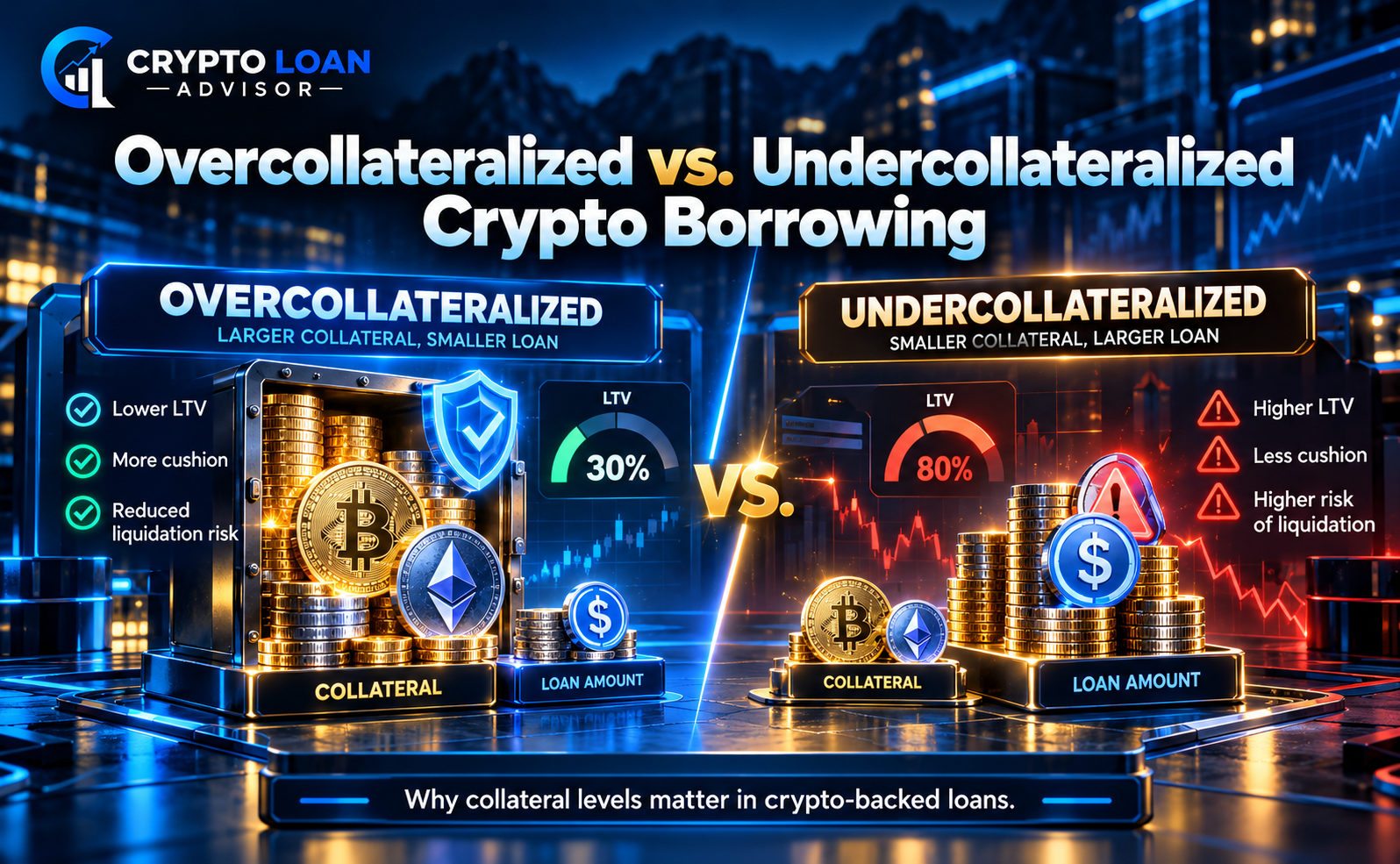
A Bitcoin holder who needs $50,000 for a business purchase faces a different decision than a borrower with a high income, strong credit, and no desire to post digital assets. The choice between overcollateralized versus undercollateralized crypto borrowing determines who carries the risk, what access you receive, and how a market decline could affect your position.
For long-term holders, borrowing can preserve ownership rather than forcing a sale at the wrong time. But “Borrow, Don’t Sell” only works when the loan structure fits both your balance sheet and your risk tolerance. The most common structure in crypto is overcollateralized borrowing. Undercollateralized options exist, but they are more selective, more institutionally oriented, and not automatically safer.
What Overcollateralized Crypto Borrowing Means
An overcollateralized crypto loan requires you to pledge digital assets worth more than the cash or stablecoin you borrow. If you deposit $100,000 worth of Bitcoin and borrow $40,000, your starting loan-to-value ratio, or LTV, is 40%.
This structure exists because crypto prices can move quickly, seven days a week. The lender needs a cushion if the value of pledged Bitcoin, Ethereum, XRP, or Solana declines. That cushion reduces the lender’s credit risk, which is why many crypto-backed lenders can focus more on the value of your collateral than your credit score or employment history.
For a holder with substantial assets but limited traditional liquidity, that can be useful. You may access capital without selling appreciated tokens, potentially avoiding an immediate taxable sale and maintaining exposure if the market rises. The trade-off is clear: your assets are at risk if the collateral value falls too far.
LTV, margin calls, and liquidation thresholds
LTV is the central number in an overcollateralized loan. It measures your loan balance against the current value of pledged collateral. A lower starting LTV generally gives you more room before a margin call or liquidation event.
Consider a $100,000 Bitcoin collateral deposit supporting a $40,000 loan. At a 40% starting LTV, a 25% drop in Bitcoin’s value reduces collateral to $75,000. Your LTV rises to roughly 53%. If the platform’s margin-call threshold is 60% and its liquidation threshold is 70%, you still have room, but much less than you had at origination.
Every lender defines these thresholds differently. Some notify borrowers when action is needed. Some allow repayment or additional collateral deposits. Some may automatically sell collateral once the liquidation threshold is reached. A borrower should never assume there will be time to react during a sharp weekend move.
What Undercollateralized Crypto Borrowing Means
Undercollateralized borrowing means the borrower provides collateral worth less than the loan amount, or in some cases no collateral at all. Rather than relying primarily on pledged assets, the lender assesses the borrower’s ability and willingness to repay through credit underwriting, income verification, business financials, legal recourse, or an established institutional relationship.
In traditional finance, unsecured personal loans and business lines of credit are familiar examples. In digital-asset finance, true undercollateralized lending is less common for individual borrowers because crypto markets are volatile and recovery can be difficult if a borrower defaults.
When it is available, undercollateralized crypto borrowing may be offered to market makers, trading firms, businesses with audited financials, or high-net-worth clients with broader relationships. Retail borrowers may encounter products marketed as low-collateral or no-collateral loans, but the fine print matters. A lender may require a personal guarantee, place limits on loan size, charge a higher rate, or impose strict eligibility requirements.
The advantage is obvious: a market decline in your crypto holdings does not automatically trigger a collateral liquidation if those holdings were never pledged. The disadvantage is that approval can be harder, pricing may be less favorable, and a default can affect your credit, business assets, or legal standing depending on the agreement.
Overcollateralized Versus Undercollateralized Crypto Borrowing: The Real Trade-Off
The comparison is not simply “more collateral is bad” and “less collateral is good.” It is a question of where risk sits.
With an overcollateralized loan, the lender takes less credit risk because it has assets securing the loan. You take more market-structure risk: falling collateral prices can force you to add assets, repay debt, or lose part of your position through liquidation. This can be a sensible structure when you hold a diversified reserve of crypto, borrow conservatively, and have liquidity available to manage volatility.
With an undercollateralized loan, the lender accepts more repayment risk. In exchange, it may demand better borrower credentials, more documentation, a higher interest rate, or contractual protections outside the crypto collateral itself. You avoid direct liquidation risk on pledged tokens, but you do not avoid debt risk. Payments are still due, interest still accrues, and default consequences can be more conventional and more personal.
For many long-term crypto investors, overcollateralized borrowing is more accessible. That does not make it the default choice for every situation. It is appropriate only if you can withstand the possibility that your collateral falls sharply while your debt balance remains unchanged.
When an Overcollateralized Loan Can Fit
An overcollateralized loan may fit a holder who has meaningful crypto exposure, needs near-term liquidity, and prefers not to sell assets they intend to own for years. It can be especially practical when the borrowing need is defined: a tax payment, real estate down payment, business investment, bridge financing, or major purchase with a credible repayment plan.
The strongest borrowers typically start with a conservative LTV rather than borrowing the maximum advertised amount. They also retain a separate liquidity reserve. If Bitcoin drops 30% or Ethereum drops 40%, they need the ability to post additional collateral or pay down the loan without selling into weakness.
This structure is a poor fit when the borrower needs every available dollar from the loan, has no cash reserve, or is already concentrated in one volatile token. Borrowing against crypto should add flexibility, not create a position where one market move dictates your financial decisions.
When Undercollateralized Borrowing Can Fit
Undercollateralized borrowing can make sense for qualified borrowers who value keeping assets outside a lender’s custody and have strong conventional financial credentials. An entrepreneur with reliable business revenue may prefer a credit-based facility over pledging a large Bitcoin position. A sophisticated trading firm may use an unsecured or lightly secured line to manage operational liquidity.
The key is to compare the full cost of capital, not just the absence of collateral. A higher interest rate, origination fees, shorter repayment term, required guarantee, or restrictive covenants can make an undercollateralized loan more expensive than it first appears.
Availability also matters. U.S. borrowers should verify whether a product is offered in their state, who originates the loan, how funds and collateral are handled, and whether the provider is transparent about underwriting and default terms. “No collateral” should prompt more questions, not fewer.
How to Evaluate Either Structure Before You Borrow
Start by modeling a bad market scenario, not a favorable one. If your collateral drops 30%, 50%, or more, what happens to your LTV? At what point would you receive a margin call? How much additional collateral or cash would you need to avoid liquidation?
Then examine the loan terms as a complete package. Focus on the interest rate and whether it is fixed or variable, the repayment schedule, origination and withdrawal fees, minimum and maximum LTV, liquidation mechanics, custody arrangements, and whether the lender can change terms under specified conditions.
You should also separate a loan’s purpose from your market view. Borrowing because you have a specific capital need is different from borrowing to make a leveraged bet on more crypto. The first can support financial flexibility. The second compounds risk, especially when the asset securing the loan is volatile.
Independent comparison matters because loan offers can look similar at the headline level while creating very different outcomes during market stress. CryptoLoanAdvisor’s investor-first framework is simple: understand the collateral, understand the trigger points, and borrow only at a level you can manage without depending on a perfect market.
A well-structured loan should leave you with choices. Before signing, ask yourself one final question: if your collateral loses half its value next month, can you still act from a position of strength?




